

Introduction
The path to becoming a professional tattoo artist has historically been demanding, unpredictable, and not particularly welcoming to newcomers. The traditional apprenticeship model has served the industry for generations, but it has never been without its difficulties. Aspiring artists have long been expected to find an established tattooist willing to mentor them, often work without pay for years, and absorb knowledge in a setting that varies wildly depending entirely on who the mentor is and how seriously they take teaching.
That model still exists, and for many people it remains a valuable experience. But it is no longer the only serious path into the profession. Structured online education in tattooing has matured significantly in recent years, and today there are programs built by working professionals that offer a rigorous, organized, and genuinely effective alternative. Hugo Feist’s online course is one of the most respected of these programs. It takes aspiring tattoo artists through a comprehensive curriculum spanning drawing fundamentals, design theory, technical machine work, hygiene protocols, and the business side of running a sustainable career in the industry.
This article covers every stage of how to become a tattoo artist, from the earliest foundations through to professional practice, and explains at each step how Hugo Feist’s course supports that journey. Whether you are starting from scratch with no formal art training or you are an experienced illustrator ready to translate your skills into tattooing, this guide gives you a clear and honest picture of what the process looks like and what it genuinely takes to succeed.
What a Tattoo Artist Actually Does and What the Career Involves
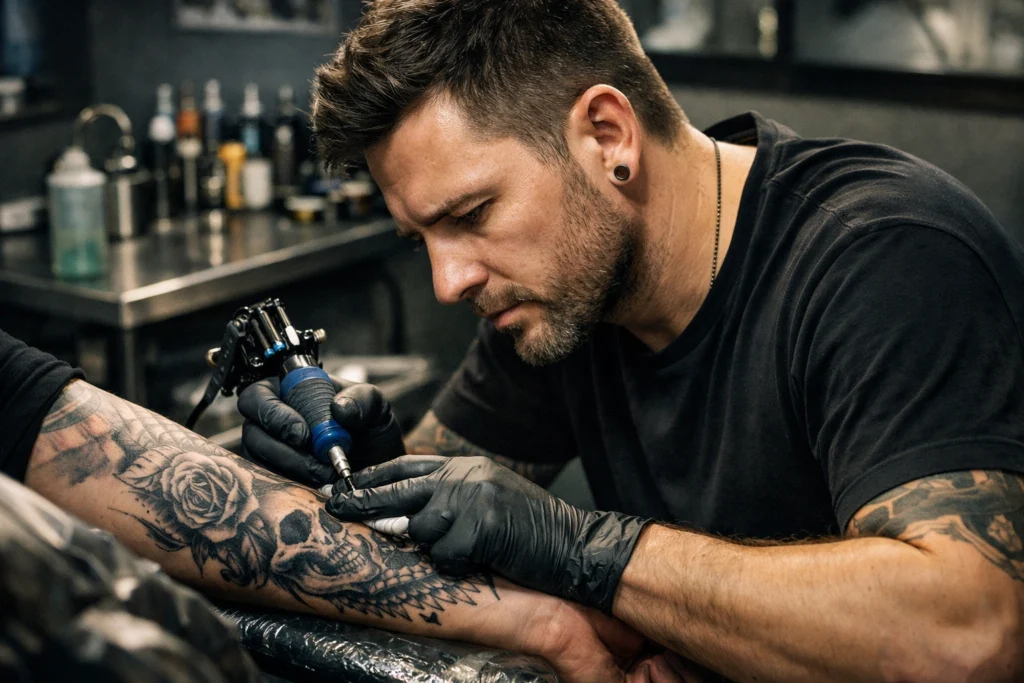
Before beginning any training, it is worth taking an honest look at what a professional tattoo artist’s daily reality involves. Most people see the creative side of the work, the finished tattoo on skin, and assume that is the majority of the job. It is not. The visible artistry represents only one dimension of a career that is also deeply technical, physically demanding, and heavily client-facing.
A working tattoo artist consults with clients to understand their ideas and translates those ideas into original custom designs. They prepare stencils, maintain a sterile workspace, manage booking and scheduling, handle the business side of their practice, build and sustain client relationships over years, and stay current with evolving techniques and trends in the industry. On the technical side, they must understand machine operation, needle selection, ink viscosity, skin tension management, needle depth across different body locations, and how different skin types respond to the tattooing process.
Tattooing is permanent. That permanence is what sets this art form apart from nearly every other creative discipline and why professional standards within the industry are genuinely high. Understanding this reality from the outset is not meant to discourage anyone. It is the foundation on which all meaningful training must be built. Hugo Feist’s course begins exactly here, by framing the full scope of the craft so that students enter the learning process with clear and realistic expectations.
Building Your Drawing Skills and Choosing Your Tattoo Style

Every experienced tattoo artist, regardless of their style or specialty, will tell you that the ability to draw well is the single most important prerequisite for learning to tattoo. The machine is a tool. What it produces is only as good as the eye, the hand, and the design sense of the person holding it. Before touching a tattoo machine, an aspiring artist needs to draw with confidence, consistency, and accuracy.
This means maintaining a regular drawing practice. Fill sketchbooks consistently. Draw from life, from reference material, and from imagination. Study the foundational principles of proportion, perspective, value, line weight, and composition. Learn to understand the human figure well enough to know how designs will sit on different body parts. Study the work of tattoo artists whose output genuinely inspires you, not to reproduce it but to understand the decisions behind it and why those choices serve the design.
Hugo Feist’s course addresses drawing as a dedicated curriculum segment, specifically focused on translating flat design into a three-dimensional surface, the role of line weight in readability at different scales, and how shading values behave differently in ink on skin compared to graphite or digital media. This is drawing instruction built specifically for the demands of tattooing, which makes it far more valuable than any general art course.
Alongside drawing, aspiring artists must identify the tattoo style that aligns with their natural strengths and genuine creative interests. Tattooing encompasses many distinct visual styles including traditional American, Japanese, blackwork, fine line, neo-traditional, realism, watercolor, geometric, tribal, and illustrative. Each style places different demands on the artist in terms of needle configuration, machine settings, line confidence, pacing, and design construction. Understanding these distinctions early prevents the confusion that comes from trying to develop in too many directions at once. Hugo Feist’s course incorporates stylistic study into its design curriculum so that students make a focused creative choice backed by real understanding rather than simply chasing whatever happens to be trending.
Developing a Professional Portfolio and Online Presence

A portfolio is the single most important document in a tattoo artist’s professional life. It determines whether established artists will consider mentoring you, whether studios will hire you, and whether clients will trust you with their skin. Portfolio development is not something to rush or treat as a finishing task. It is a continuous process that begins during the earliest stages of training and never fully stops.
A strong tattoo-focused portfolio includes original designs across multiple styles, demonstrations of clean and confident linework, evidence of shading skill and value control, flash sheet compositions, and photographs of any tattoos applied to skin, even if on practice materials in the early stages. Curating the portfolio matters as much as filling it. Every piece included should represent the standard you want to be hired or mentored at. Anything below that standard should be left out regardless of how much effort went into producing it.
Hugo Feist’s course includes dedicated portfolio guidance covering what to include at each stage of training, how to photograph and present work for maximum impact, and how to use digital platforms to build visibility with the right audience. Building a consistent and professional social media presence runs parallel to portfolio development. In the modern tattoo industry, platforms like Instagram function as the primary portfolio window for potential clients and collaborators. Artists who treat their online presence as an afterthought consistently leave significant professional opportunity unrealized regardless of their technical ability. The course addresses this directly, recognizing that digital visibility is now a core business development tool for any serious working artist.
Mastering Equipment, Technique, and Skin Anatomy
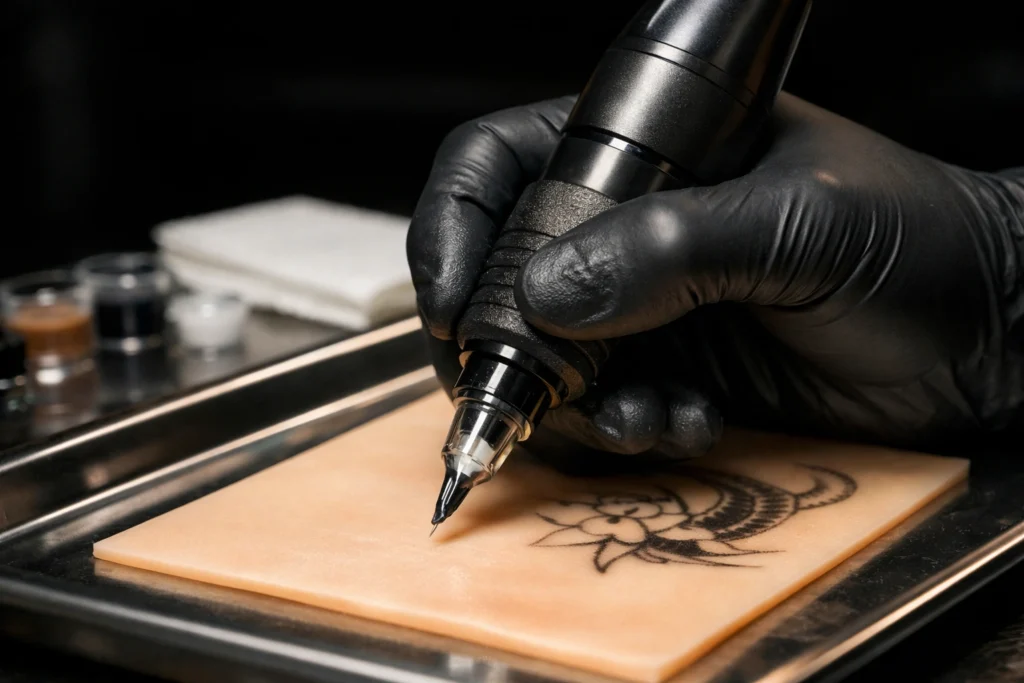
A tattoo machine is a precision instrument and learning to use one well takes time, deliberate practice, and a thorough understanding of how it functions. The two primary categories are coil machines and rotary machines. Many contemporary artists prefer rotary machines for their quieter operation, smoother movement, and lower entry barrier. Beyond the machine itself, artists need to understand needle configurations and their relationship to different techniques. Round liners produce clean outlines. Magnum needles are used for shading and color packing. Curved magnums are preferred by many realism artists for their ability to create soft, natural gradients.
The relationship between needle depth, machine speed, voltage settings, and hand speed determines the final result on skin. Developing this understanding requires both instruction and extensive hands-on repetition. Hugo Feist’s course walks students through machine mechanics, needle selection, setup procedures, and the practical relationship between settings and technique. This technical foundation prevents the guesswork that leads to uneven lines, blown-out shading, and the inconsistency that plagues self-taught artists who skip this stage.
Before working on real clients, extensive practice on synthetic skin is essential. Artificial practice skin closely approximates the resistance and texture of real skin, allowing students to develop technique, machine control, and design execution in a consequence-free environment. During this phase the focus should be on linework consistency, needle entry angle, maintaining uniform pressure, and managing hand speed relative to machine settings. Hugo Feist’s course structures this practice phase with specific exercises designed to build technical competence progressively.
Understanding skin anatomy is equally critical. The skin varies in thickness, elasticity, and texture across different body locations. It responds differently based on the client’s age, hydration level, sun exposure, and the specific body part being tattooed. Areas like the inner wrist, elbow ditch, and ribcage are notoriously challenging because of how the skin moves and sits over underlying bone and muscle. The course addresses skin anatomy and its practical implications in a way that is directly applicable in the chair, giving students the context to make smart decisions about needle depth and technique adjustment across different clients and body locations.
Hygiene, Safety, Licensing, and Legal Requirements

Tattooing involves breaking the skin and introducing ink into the dermis, which means the standards around hygiene and safety are genuinely non-negotiable. Bloodborne pathogens, cross-contamination risks, allergic reactions to ink formulations, infection prevention, and proper disposal of sharps are all areas that every professional tattoo artist must understand completely and manage without exception.
Most jurisdictions require tattoo artists to hold a bloodborne pathogens certification that meets OSHA standards before they are permitted to practice professionally. Many states and countries also require a tattoo-specific license obtained through the local health department, which can involve inspections, written examinations, and documented hours of supervised practice. Requirements vary by jurisdiction, so researching the specific regulations in your area is an essential early step.
Hugo Feist’s course covers hygiene and safety protocols as a foundational module rather than an afterthought, reflecting the reality that safe practice is inseparable from artistry. Artists who treat safety as secondary to the creative work do not last long in a professional environment, and the consequences of cutting corners extend well beyond professional reputation. The course also addresses licensing and legal compliance in general terms while directing students to verify requirements in their local jurisdiction, producing graduates who are genuinely ready to work professionally rather than just technically capable in isolation.
Building a Sustainable Tattoo Career for the Long Term
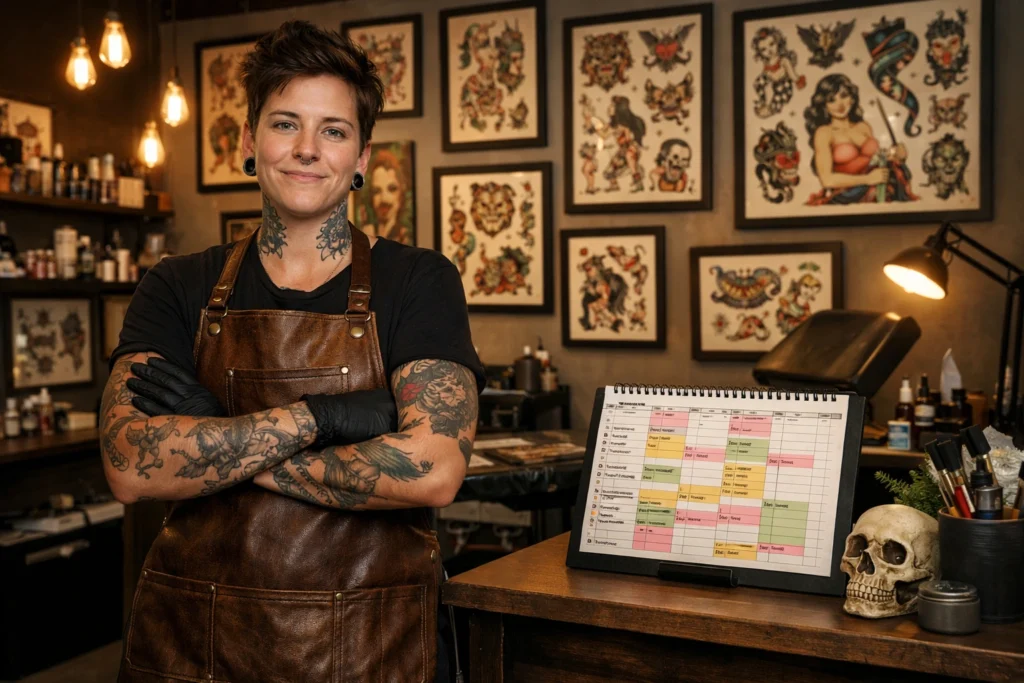
The technical and artistic sides of tattooing are the foundation of a career, but they are not enough on their own to build a financially stable and creatively rewarding professional life. The business side of tattooing, pricing, booking management, client retention, reputation building, and eventually the possibility of studio ownership, requires a distinct set of skills and a deliberate approach that many talented artists neglect until they find themselves struggling unnecessarily.
Pricing work appropriately is one of the most common challenges new tattoo artists face. Undercharging beyond the early stages communicates a lack of professional confidence and attracts clients who do not value the work at its true level. Understanding your market, knowing what your time and skill are worth, and charging accordingly is a business decision that directly determines the quality of your professional experience.
Continuing education is equally important. The most respected artists in the industry are those who never stop studying, practicing, and pushing the limits of what they are capable of. Attending conventions allows artists to observe peers and industry leaders, enter competitions, and stay current with emerging trends. Workshops with artists who specialize in techniques outside your primary style expand your capabilities and prevent the stagnation that comes from working in a narrow range over a long period.
Hugo Feist’s course addresses the business fundamentals of building a tattoo career because it was built by someone who has navigated this journey firsthand. The goal is not to produce technically competent tattooers in isolation. It is to produce fully formed professional tattoo artists who are ready to build careers that are rewarding, financially viable, and creatively fulfilling over the long term. Hugo also maintains an active teaching and creative practice and updates the course material regularly to reflect developments in technique, equipment, and industry standards, modeling the attitude toward continuous learning that every serious artist needs to carry throughout their career.
Conclusion
Learning how to become a tattoo artist is a commitment that asks a great deal from anyone who undertakes it seriously. It requires genuine artistic development, technical mastery across multiple dimensions, a thorough understanding of health and safety practice, professional business sense, and the kind of sustained dedication that does not waver when the early stages feel slow or difficult. It is not a casual pursuit. It is a career that rewards those who approach it with the seriousness and respect it deserves.
Hugo Feist’s online course offers a structured, professional, and comprehensive pathway into this career that is accessible regardless of where you live, what your schedule looks like, or whether you have existing connections within the industry. It is not a shortcut. It is a well-designed map for a journey that still requires every student to do the actual work. With the right curriculum, the right instruction, and a genuine commitment to developing real skill, the path to becoming a professional tattoo artist is more achievable today than it has ever been.
You may like this post: Gifts For Tattoo Artist: 15 Creative Finds They’ll Actually Love
Frequently Asked Questions
How long does it take to become a tattoo artist through an online cmay ourse?
The timeline varies depending on how much time you dedicate each week and your existing artistic skill level. Most students working consistently through Hugo Feist’s course develop a professional foundation within six to twelve months. Building a full portfolio and reaching the point of tattooing clients professionally typically takes between one and two years of committed practice.
Do I need formal art training before starting Hugo Feist’s course?
Formal art education is not required. The course begins with foundational drawing instruction specific to tattooing, which means students without a fine arts background can build the skills they need as part of the curriculum. However, students who arrive with existing drawing experience will typically progress more quickly through the early modules.
Can I get a tattoo license without completing a traditional apprenticeship?
In many jurisdictions, yes. Licensing requirements vary significantly by state and country, and a growing number of regions recognize structured educational programs as a valid pathway to licensure. Completing a rigorous course like Hugo Feist’s gives you the foundational credentials and documented training that many licensing processes require.
Is tattooing a financially viable career?
Yes, for artists who build their skills, establish a strong portfolio, and develop a consistent client base. Established tattoo artists typically earn between fifty thousand and eighty thousand dollars annually, with experienced artists in high-demand markets earning significantly more. The key variables are skill level, reputation, location, and the quality of business decisions made throughout the career.
What equipment do I need to start practicing as a beginner?
To begin practicing, you need a quality rotary tattoo machine, a selection of needle configurations including round liners and magnums, professional tattoo ink, synthetic practice skin, transfer paper, a stencil solution, gloves, and proper sharps disposal containers. Hugo Feist’s course includes a recommended equipment list at the appropriate stage of the curriculum so students invest in the right tools at the right time without unnecessary early expense.
1 Comment