
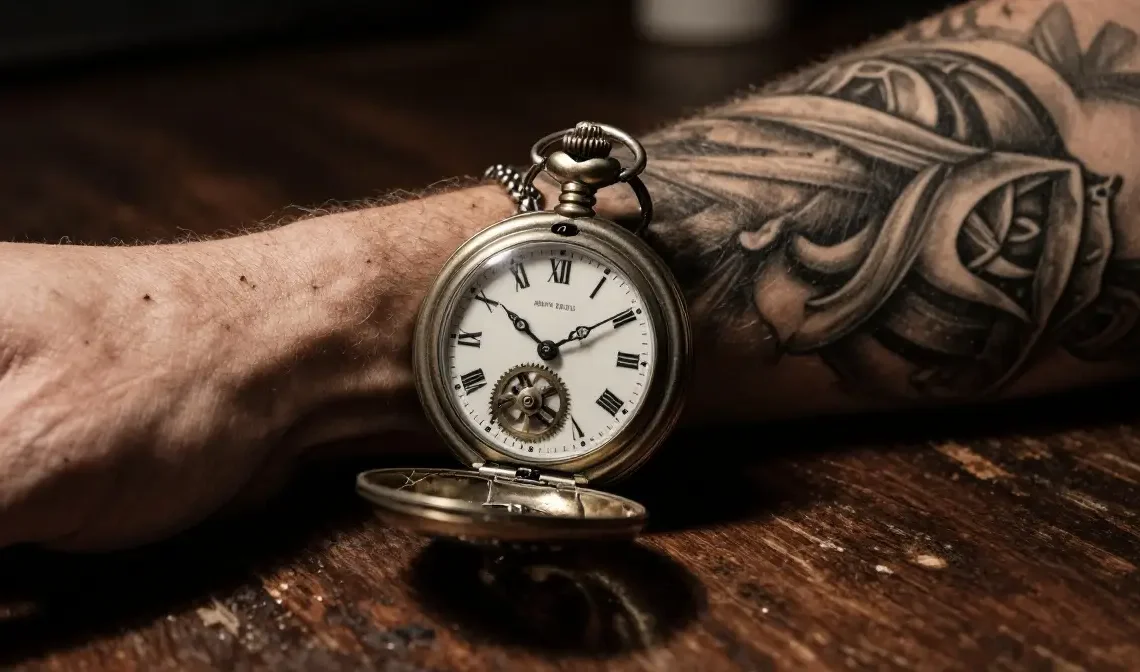
Few tattoo motifs carry as much layered gravitas as the pocket watch tattoo. These designs transcend mere decoration. They speak — loudly — about who you are, what you’ve lost, and what you refuse to forget. Across American tattoo studios, from Brooklyn to Los Angeles, this motif continues to dominate consultation books year after year. It isn’t a trend. It’s a permanent love affair between ink and the concept of time itself.
Why Timepiece Tattoos Have Never Lost Their Cultural Power
Timepiece body art sits at a remarkable intersection of aesthetics and philosophy. Time is the one resource every human shares equally yet experiences completely differently. A clock on skin becomes a statement that can’t be muted or scrolled past. It demands a second glance.
Classic era tattoo aesthetics have cyclically returned to the pocket watch as a central icon because it communicates so much without a single word. Unlike a name or a date, the circular dial of an antique timepiece tattoo conveys entire emotional universes — grief, love, urgency, surrender. That communicative density is why this motif refuses to fade.
The Hidden Symbolism Behind Every Ticking Dial and Frozen Hand
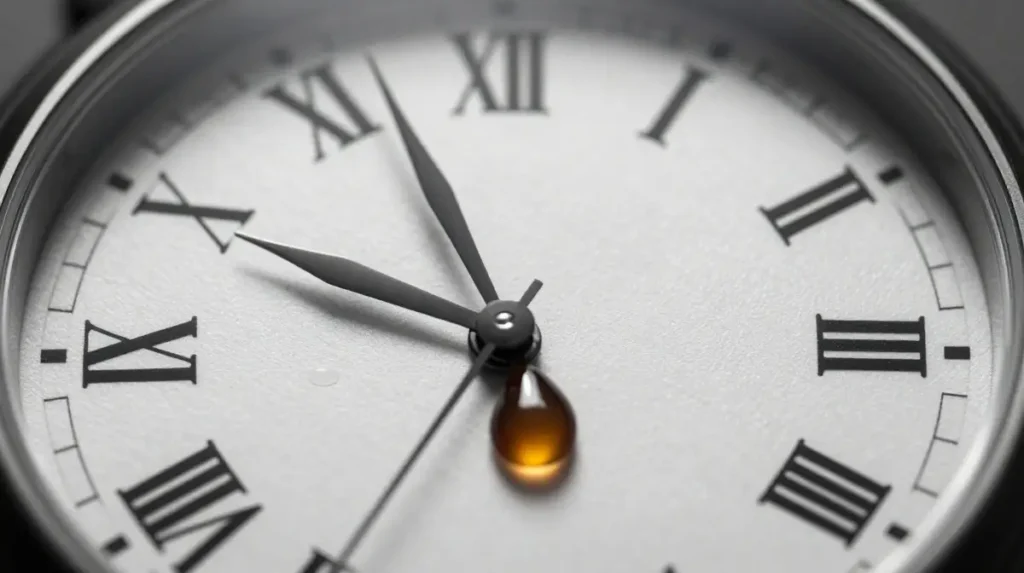
The symbolism of clock tattoos runs far deeper than most people initially realize. Every element carries weight. The hands, the numerals, the open or closed casing — each choice shifts meaning in ways that can define a person’s entire narrative. This isn’t surface-level ink. It’s philosophy pressed into dermis.
Watch hands tattoo meaning changes dramatically depending on their position. Hands frozen at 11:11 suggest hope and manifestation. Hands locked at a birth time mark entry into the world. Hands stopped at the exact moment of a loved one’s passing transform a timepiece into a mausoleum. Frozen in time tattoo concepts have moved generations of people to tears in the tattoo chair — and that emotional gravity never diminishes.
Pocket Watch Tattoos and What They Truly Say About the Person Wearing Them

Pocket watch tattoo significance reveals character in ways that subtler tattoos simply don’t. People who choose this design tend to be deeply reflective. They think about mortality without being paralyzed by it. They honor the past without being imprisoned by it. That psychological portrait is remarkably consistent across wearers.
Tattoo ideas with sentimental value often center on inherited objects and the grandfather heirloom timepiece occupies a throne in that category. When someone inks their grandfather’s actual pocket watch — scratches, dents, and all — onto their forearm, they’re performing an act of devotion that no photograph or keepsake box can replicate. The skin becomes the most intimate archive imaginable.
How Victorian Obsession With Mortality Gave Birth to Clock Ink Culture
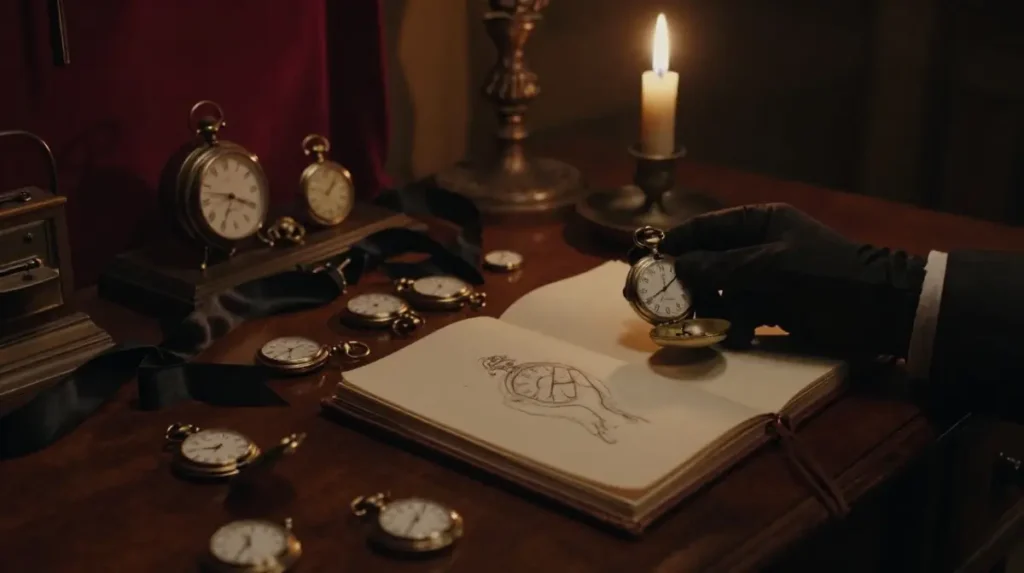
The Victorian era pocket watch wasn’t merely a timekeeping device — it was a cultural artifact saturated with meaning. Victorians were, paradoxically, both terrified of death and obsessed with commemorating it beautifully. They wore hair of the deceased in lockets. They photographed the dead. They engraved memento mori motifs onto every surface they could find — including watch cases.
Heritage and legacy tattoo themes draw a direct ancestral line back to this Victorian sensibility. Clock tattoo symbolism death and life didn’t originate in modern tattoo parlors. It was born in the grief-soaked drawing rooms of 19th-century England and America where time wasn’t taken for granted. Wearers today inherit that entire historical weight whether they know it or not — and most, once they learn it, feel even more deeply connected to their design.
Choosing the Right Style Before Your Tattoo Artist Draws a Single Line
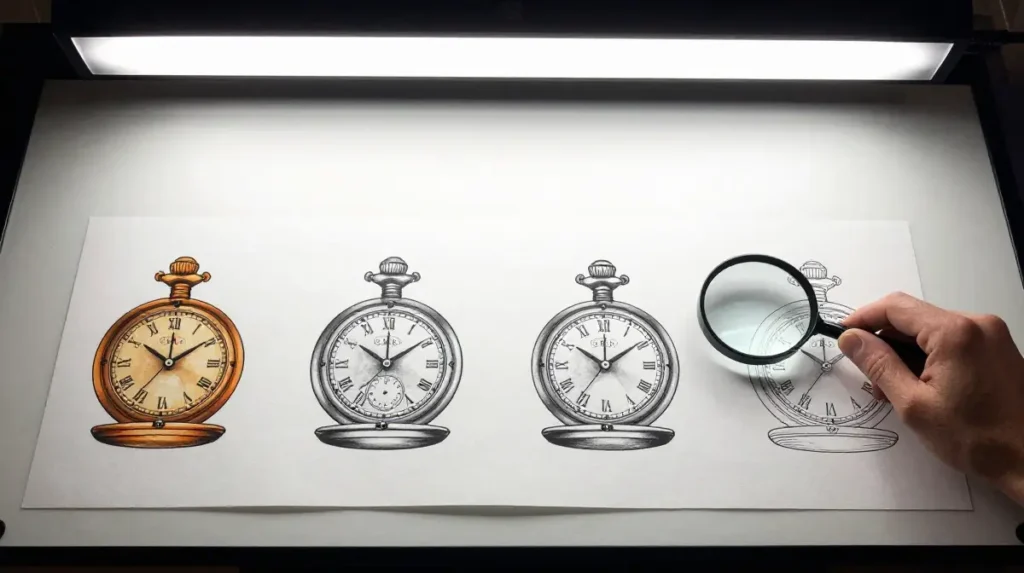
Style selection is the single most consequential decision you’ll make before sitting in the chair. Vintage watch tattoo ideas can be executed in a dozen distinct stylistic languages and each one produces a radically different emotional register. Rushing this decision is the fastest route to regret. Take weeks if you need to. Your skin deserves that deliberation.
Neo traditional tattoo style brings bold outlines, rich jewel-toned color saturation, and exaggerated floral and decorative elements that feel simultaneously vintage and modern. Traditional American tattoo style strips things back to thick black outlines and a limited, punchy color palette with zero apology. Japanese irezumi time motif integrates the watch into flowing backgrounds of waves, koi, or cherry blossoms — transforming a Western object into something transcendent and cross-cultural. Know your aesthetic language before your consultation.
Black and Grey Realism vs Neo Traditional — Which Renders Better on Skin
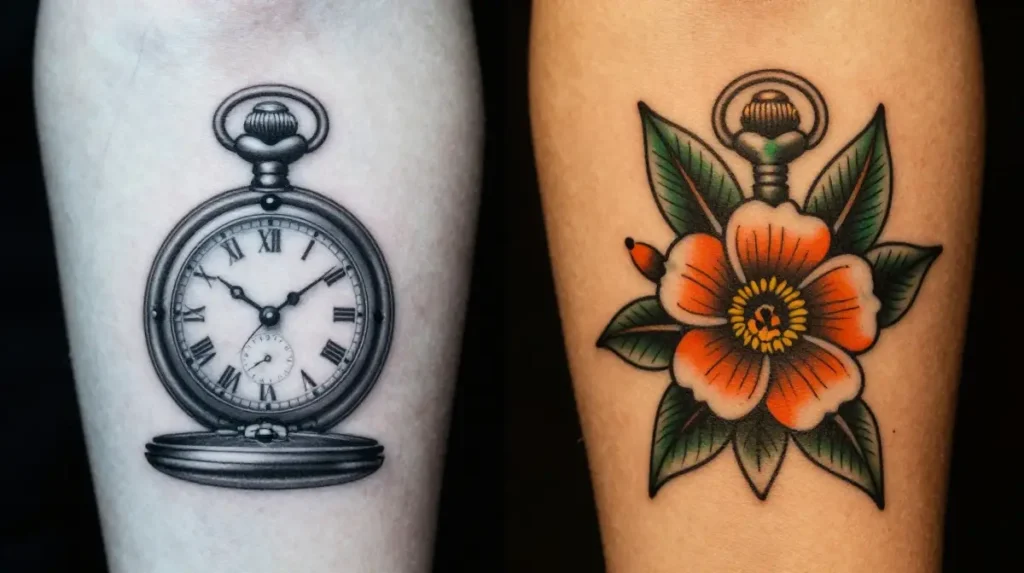
Black and grey pocket watch realism is arguably the most technically demanding style in the tattooist’s repertoire. Achieving photographic depth on curved, living, aging skin requires an artist who genuinely understands how light behaves on three-dimensional metal surfaces. When executed correctly, the result is staggering — a piece that looks like a daguerreotype pressed permanently into skin.
Pocket watch tattoo shading technique in the realism genre relies heavily on smooth gradient transitions, precise highlight placement, and a mastery of negative space. Timepiece tattoo negative space technique uses the skin’s natural tone as the brightest light source — a counterintuitive but breathtaking approach. Neo traditional renders differently: it’s bolder, more graphic, more immediately legible from across a room. Both are valid. Your lifestyle, skin tone, and pain threshold for long sessions should guide the final call.
Why Placement Changes Everything When Working With Circular Tattoo Designs

Circular compositions behave unlike any other tattoo shape. They need anatomical real estate that complements their geometry — curved surfaces that let the eye travel around the design naturally rather than interrupting it. A pocket watch tattoo placement guide that ignores anatomy is setting you up for distortion and disappointment.
you may also like this:22 Book Lover Tattoos Ideas for Creative Reader Ink
Vintage horology tattoo designs placed on the back of the hand, for instance, will distort dramatically every time the fingers flex. The flat inner forearm, the outer upper arm, the thigh, and the chest offer far more stable canvases. Clock face tattoo art needs breathing room too. Squeezing a detailed dial into a space too small for it compresses every element into visual noise. Bigger is almost always better for this motif — don’t let hesitation shrink your vision.
The Chest, Thigh, and Forearm — Prime Real Estate for Watch Face Compositions
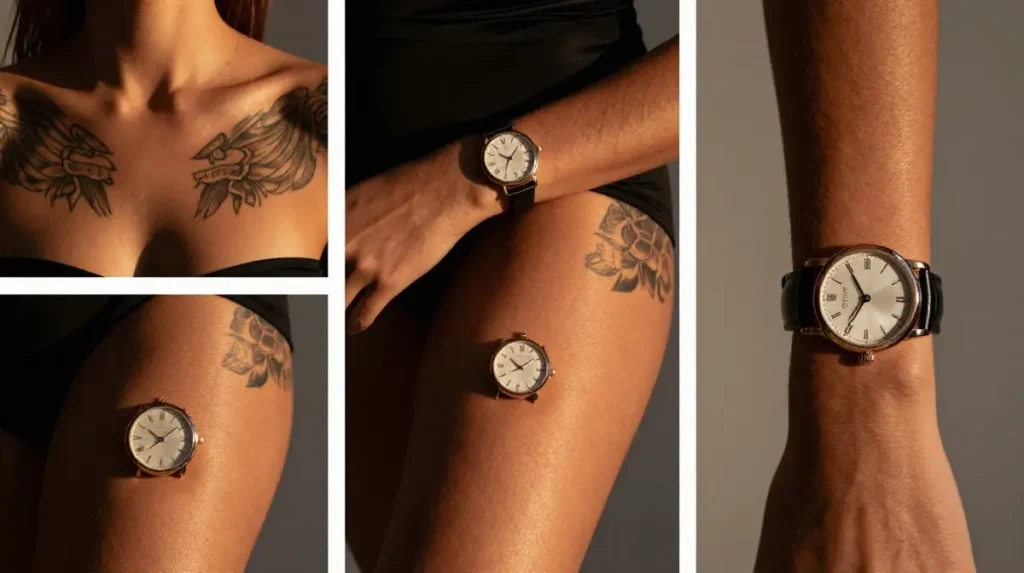
The forearm has earned its reputation as the premier location for pocket watch tattoo designs for good reason. It’s a naturally flat, elongated canvas that’s almost always visible — meaning your piece gets seen, appreciated, and preserved through minimal sun exposure when you dress for work. The inner forearm in particular offers exceptional skin stability over decades.
Pocket watch tattoo sleeve composition takes placement strategy to its most ambitious level. When the watch becomes the centerpiece of a full sleeve — flanked by roses, chains, celestial elements, or biographical dates — the forearm becomes a narrative scroll. The thigh, meanwhile, offers the largest uninterrupted canvas on the human body. Open face watch tattoo rendering on the outer thigh can reach extraordinary scale without the distortion risks of joint-adjacent placements. The chest sits above the heart — a placement choice so symbolically loaded it practically writes its own story.
How Skilled Artists Build Depth Into Antique Timepiece Tattoo Renderings
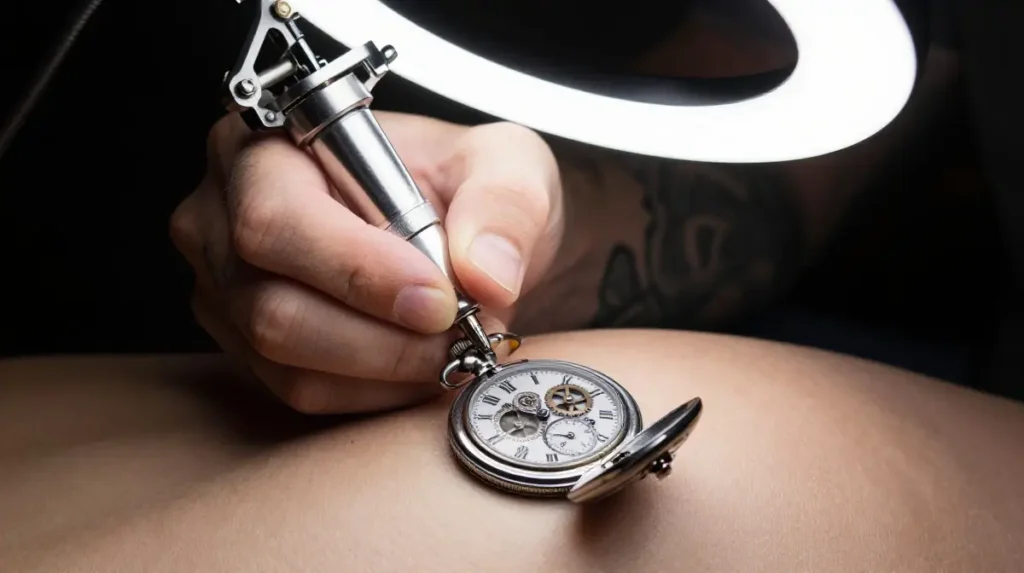
Depth in a vintage timepiece body art piece isn’t accidental. It’s architectural. A masterful artist constructs the composition in deliberate layers — background atmosphere first, then the mid-ground casing, then the dial face, then the hands and numerals at the very forefront. Each layer sits at a different visual depth and that stacking is what separates a flat illustration from a piece that appears to actually exist in three-dimensional space.
Intricate gear and cog tattoo detail — often visible through an open or shattered casing — adds mechanical authenticity that elevates the entire composition. Ornate clock face body art reaches its full potential when an artist renders the bezel, the winding crown, the crystal, and the dial texture as distinct materials with distinct light behaviors. Brass reads differently than glass which reads differently than aged leather strapping. An artist who understands material-specific rendering will create something that doesn’t just look good — it looks real.
Roses, Skulls, and Compasses — The Companions That Elevate a Watch Tattoo

No tattoo motif exists in total isolation and the pocket watch is particularly magnanimous about what it shares space with. Rose and pocket watch tattoo fusion is perhaps the most enduring pairing in American tattoo history — the rose softening the mechanical rigidity of the dial while simultaneously introducing themes of beauty, love, and inevitably, decay. It’s a conversation between two icons.
Skull and pocket watch tattoo combinations speak directly to clock tattoo symbolism death and life — two of the most powerful symbolic objects in body art locked in permanent dialogue on skin. Compass and watch tattoo pairings speak to navigation and purpose — the watch measures when and the compass determines where, together suggesting a life lived with both direction and intention. Chain pocket watch tattoo designs add a literal tether — the chain connecting the watch to something anchoring, whether that’s a belt loop, a breast pocket, or metaphorically, a relationship or a memory.
What Frozen Clock Hands Mean and Why That Single Detail Moves People to Tears

The frozen clock hand is perhaps the most emotionally detonating detail in all of time themed tattoo ideas. It’s a single choice — locking the hands at one specific moment — that transforms a decorative motif into a monument. People stop. They ask. And when the wearer explains, the conversation that follows is rarely brief.
Broken watch face tattoo symbolism operates in the same emotional territory. A shattered crystal doesn’t necessarily mean destruction — sometimes it means preservation. The moment captured beneath broken glass is protected precisely because it can no longer change. Watch face tattoo spiritual meaning varies by tradition: in some belief systems a stopped clock represents the soul’s departure from linear time. In others it marks the exact moment life pivoted permanently. Either way, that frozen hour and minute hand does what language can’t — it fixes something ephemeral into something you can touch.
How Roman Numerals Transform a Simple Watch Face Into Personal Sacred Text

Roman numeral watch tattoo designs bring an element of antiquity that Arabic numerals simply can’t replicate. There’s something about the vertical strokes and horizontal serifs of Roman characters that immediately signals permanence and gravitas. On a watch face, they don’t just mark hours — they consecrate them.
Roman numeral placement on watch face requires genuine typographic consideration. The numerals should follow the circular baseline of the dial naturally and a skilled artist won’t simply place them — they’ll letter them as if they were hand-engraved by a Victorian watchmaker. Antique watch tattoo with floral surround designs frequently use Roman numerals as their typographic anchor — the numerals providing structure while vines, roses, or forget-me-nots flow organically around the casing. That contrast between rigid numeral and organic floral is one of the most satisfying visual tensions in all of pocket watch tattoo designs.
Memorial Tattoos That Honor Loved Ones Through the Dial of a Cherished Watch
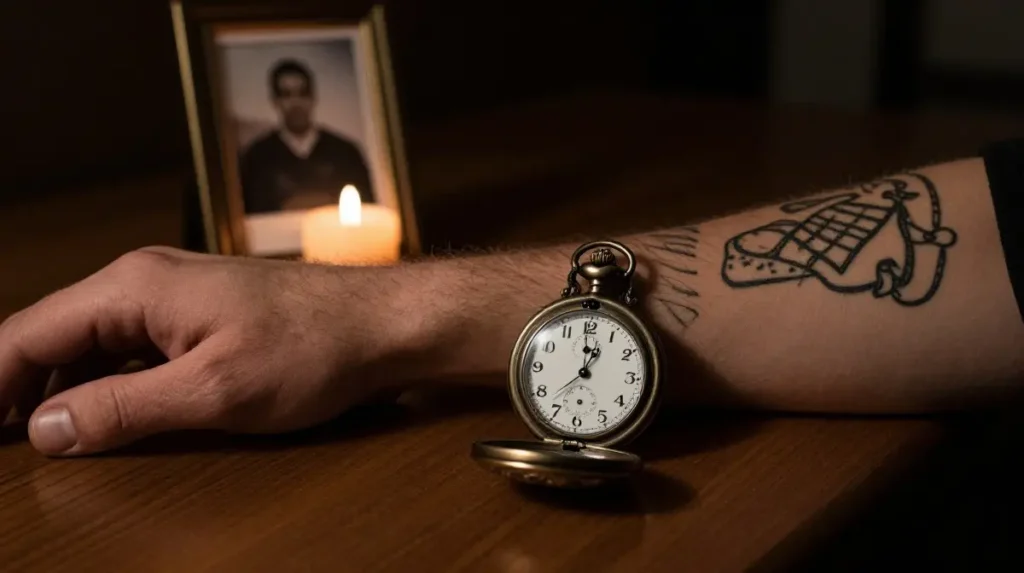
Memorial pocket watch tattoo tribute designs carry a weight that almost no other tattoo category can match. When you choose to immortalize a loved one through a pocket watch tattoo, you’re not just choosing an image — you’re choosing a philosophical framework for your grief. You’re saying: time matters. This moment mattered. And I will carry it everywhere I go, forever.
Memorial tattoo concept designs built around an actual inherited pocket watch often incorporate the exact engravings, scratches, and patina of the real object. Heirloom watch tattoo design at its finest is essentially portraiture — a faithful rendering of a specific, irreplaceable object rather than a generic clock. Some clients provide photographs of their grandfather’s watch and ask their artist to reproduce every nick and worn edge. The result is something that belongs to no one else on earth. That singularity is the point.
Steampunk Gears, Chains and Cogs — When Mechanical Detail Becomes Pure Art

Steampunk aesthetic tattoo design has built an entire visual universe around the internal anatomy of mechanical timepieces. Exposed gears, flying tourbillons, mainspring barrels, escapement wheels — these components that most people never see become the stars of a steampunk watch tattoo composition. The result is tattoo art that feels simultaneously industrial and fantastical.
Steampunk pocket watch full sleeve designs are among the most ambitious undertakings in contemporary tattooing. They demand an artist fluent in mechanical illustration — someone who can render the interlocking logic of clockwork convincingly even when the gears are fictional. Chain and locket watch tattoo design in the steampunk genre often incorporates exposed links, cogs of varying sizes, and a sense that the entire arm is a visible clockwork mechanism. Intricate gear tattoo details at this level of complexity require multiple long sessions and an artist who plans the negative space as carefully as the inked areas.
Pocket Watch Tattoos Built Around Birth Dates, Death Dates and Defining Moments
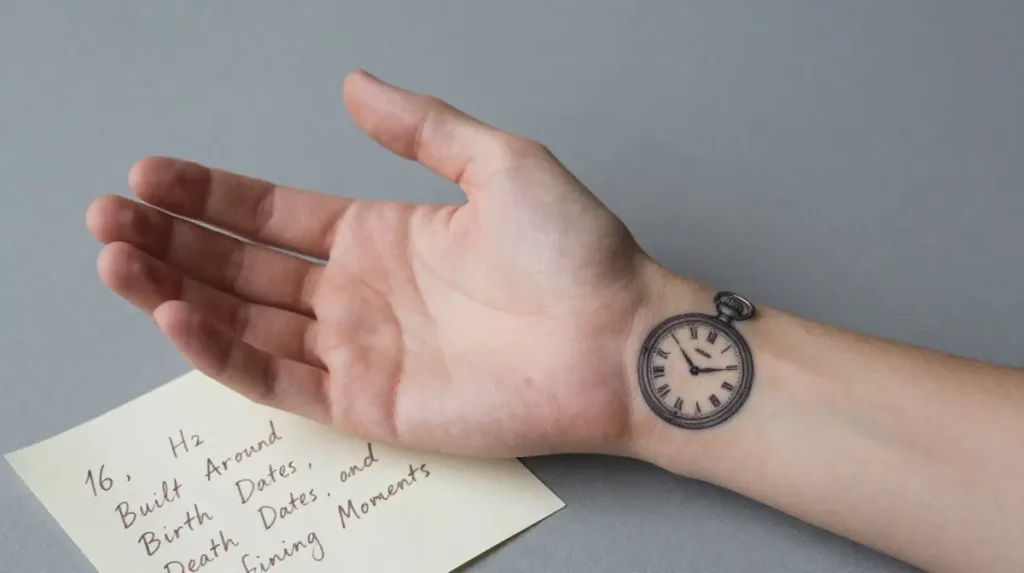
Pocket watch tattoo with birth date designs anchor the motif in personal biography rather than abstract philosophy. The birth date becomes the time displayed on the dial — a literal freezing of the moment a specific life began. That specificity transforms the piece from art into autobiography. It’s impossible to replicate on anyone else’s body.
Tattoo designs representing time and memory reach their most biographical potential when the date encoded in the design belongs not to the wearer but to someone they love or have lost. A parent’s birth year worked into the Roman numerals. A child’s exact birth time set into the dial hands. These choices make the pocket watch tattoo significance profoundly personal. Fob watch tattoo art — referencing the style of watch worn on a chain attached to a waistcoat — adds a further historical specificity that elevates the design above generic clock imagery into something genuinely era-specific and elegantly researched.
Fine Line Techniques That Make Intricate Dial Work Look Impossibly Delicate
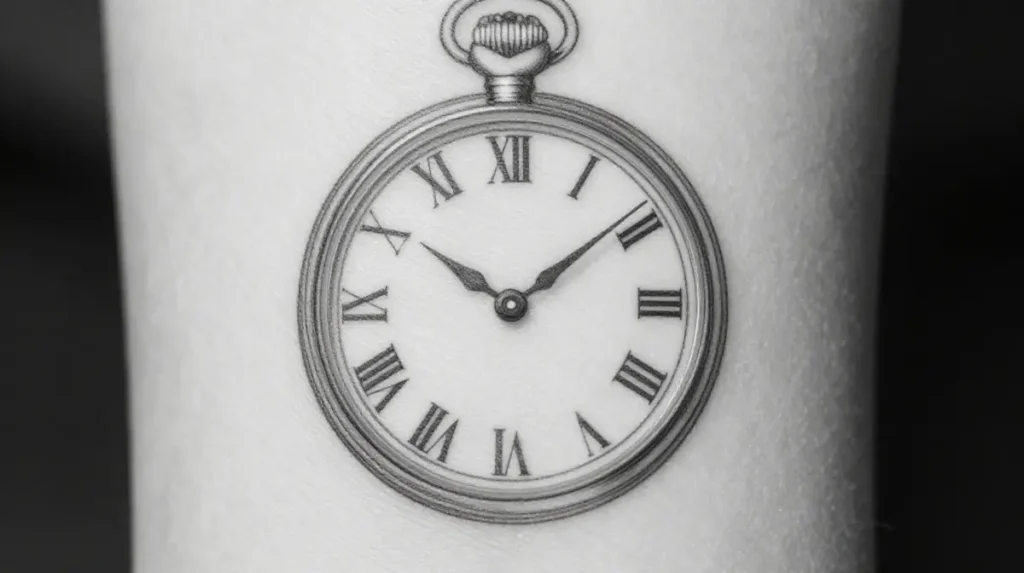
Fine line tattoo detail has revolutionized what’s possible in antique object tattoo designs. Where traditional tattooing required bold outlines to maintain legibility over time, fine line work operates at the very edge of precision — hairline strokes that create extraordinary detail in minimal space. Applied to a pocket watch tattoo, fine line technique produces something that resembles a master engraver’s work more than conventional ink.
The caveat is real: fine line tattoo detail requires exceptional aftercare and sun protection to maintain its integrity over years. Fine lines spread in skin over time — it’s simply how dermis behaves. A piece that looks like a whisper at year one can blur into illegibility by year ten without diligent SPF application. Discuss longevity openly with your artist. Some practitioners now offer annual touch-up sessions specifically for fine line clients. It’s a relationship, not a one-time transaction.
How Watercolor Backgrounds Turn Vintage Timepiece Designs Into Wearable Paintings

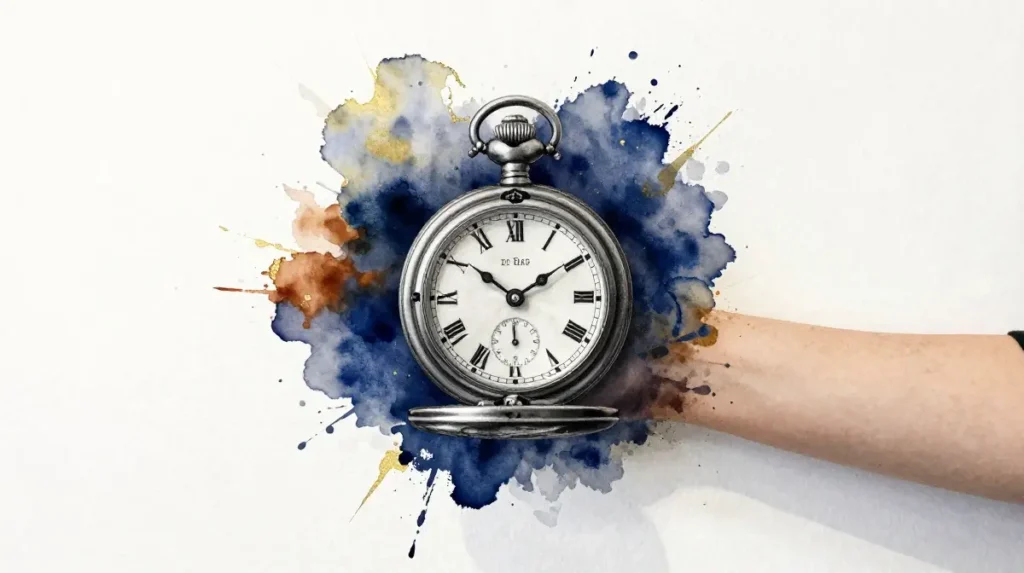
Watercolor tattoo technique applied behind a vintage watch tattoo idea creates one of the most visually arresting contrasts in contemporary body art. The rigid, mechanical precision of the watch face set against loose, bleeding washes of color produces a tension that’s genuinely beautiful — structure and chaos in permanent conversation.
Nostalgic clock ink designs rendered in the watercolor style often incorporate splashes of deep indigo, burnt amber, or aged sepia — colors that echo the visual language of old photographs and antique documents. The technique works best when the watch itself is rendered in tight black and grey realism and the watercolor wash exists purely as atmospheric background. Pocket watch tattoo shading technique in this hybrid approach requires an artist fluent in two completely different technical languages simultaneously. Not every artist can do it well — so vet portfolios with this specific combination in mind before booking.
The Unexpected Beauty of Broken, Cracked and Melting Clock Face Tattoo Concepts
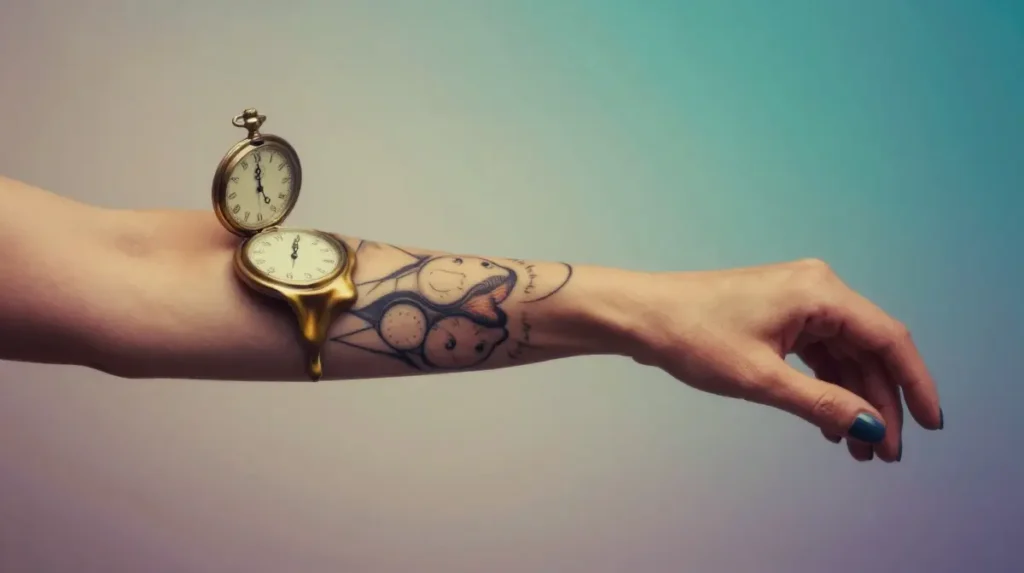
Salvador Dali melting clock imagery has haunted the visual imagination since 1931 and its influence on clock face tattoo art is impossible to overstate. The idea that time itself can become soft, malleable, and subject to emotional gravity rather than physical law is a concept that resonates profoundly with anyone who has experienced grief, joy, or trauma so intense it seemed to warp the passage of hours.
Broken watch face tattoo symbolism doesn’t require a Surrealist reference point to resonate. A cracked crystal implies a specific moment of impact — the moment something irreversible happened. Alice in Wonderland watch imagery — the White Rabbit’s frantically consulted pocket watch — introduces themes of anxiety, urgency, and the terror of being perpetually late that speak to modern experience with uncomfortable precision. Antique timepiece tattoo designs that incorporate these surreal or literary references give the piece an intellectual dimension that elevates it far beyond simple decorative body art.
What Your Tattoo Artist Needs to Know Before Inking a Highly Detailed Timepiece
Preparation is the invisible architecture of a great tattoo. Before your artist lifts the machine, you owe them context. Bring reference images — not just of the style you want but of the specific watch you’re referencing if one exists. Bring images showing the lighting and shadow quality you admire. Bring examples of tattoos whose linework or shading approaches your vision. The more visual information you provide the more precisely your artist can translate your concept into a blueprint.
Meaningful watch tattoo concepts that incorporate personal dates, names, or heirloom references require additional preparation. Write everything down. Bring the actual object if you can. Discuss skin tone honestly — black and grey realism tattoo reads differently on very light skin versus medium or dark tones and a skilled artist will adjust their approach accordingly. Discuss sizing before the stencil goes on. Most people underestimate how large a detailed piece needs to be to retain clarity as skin ages. Your artist’s size recommendation exists to protect the longevity of your investment.
Aftercare Strategies That Preserve the Sharpness of Intricate Clock Line Work
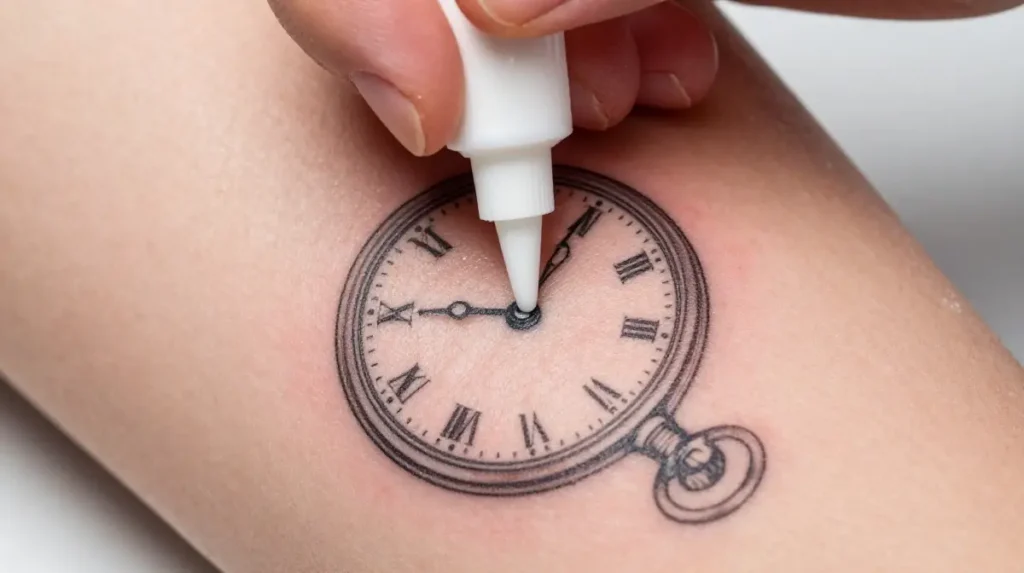
Intricate clock face tattoo art is merciless in its demands on aftercare. Every fine line, every delicately rendered numeral, every precisely placed highlight exists at the mercy of how well you treat the healing skin during the first two weeks. Neglect the aftercare and you’ll watch weeks of artistic labor begin to degrade before the piece has fully settled.
Keep it clean with fragrance-free, antimicrobial soap applied with clean hands — never a rough cloth. Apply a thin layer of unscented, alcohol-free moisturizer two to three times daily. Never submerge a healing tattoo in water. Keep it entirely out of direct sunlight during healing and use minimum SPF 50 thereafter, forever, without exception. Pocket watch tattoo shading technique that uses delicate gradients is particularly vulnerable to UV degradation — sun exposure is the single fastest way to age a tattoo prematurely. Treat sun protection as a lifelong maintenance ritual rather than an occasional afterthought.
How to Spot an Artist Whose Portfolio Proves They Can Handle Mechanical Detail
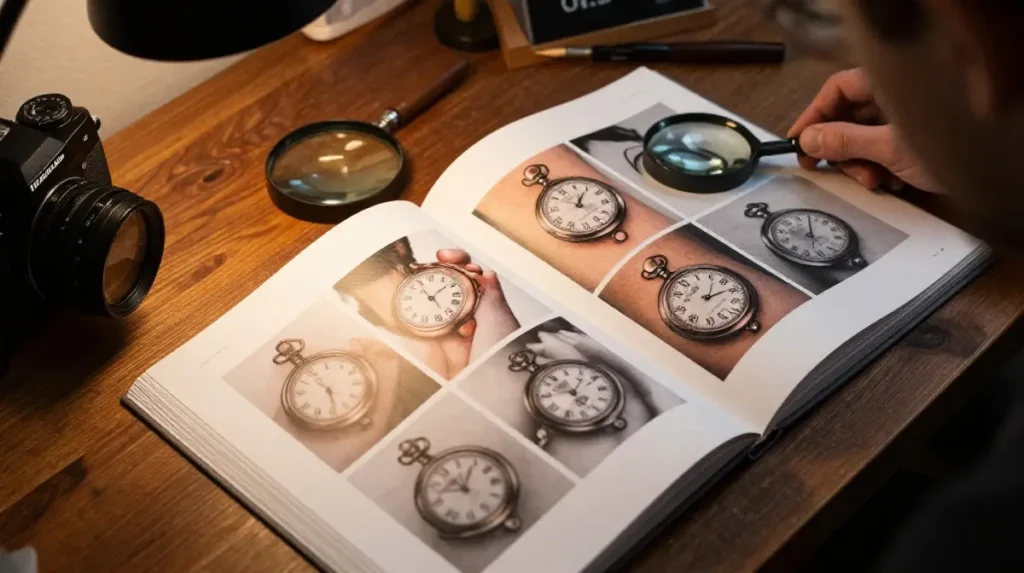
Portfolio evaluation is a skill every prospective tattoo client should develop before spending serious money on a serious piece. Detailed clock tattoo sleeve work requires an artist who can demonstrate — not just claim — mastery of mechanical form. Look for consistency across multiple healed pieces, not just fresh work. Fresh tattoos always look sharper than they’ll look at six months. The healed images are the truth.
Specifically examine how the artist handles circular forms and symmetry — watch faces that drift from true circles or have uneven numeral spacing will bother you for a lifetime. Look at their metallic rendering: does the casing look like actual polished brass or engraved silver or does it look flat and unconvincing? Study their background work — does negative space serve the composition or just fill it? Old pocket watch ink done poorly is one of the hardest things to cover or rework. Choose with the same rigor you’d apply to selecting a surgeon. Because in many ways, that’s exactly what a tattoo artist is.
Mistakes That Ruin Pocket Watch Tattoos and Exactly How to Avoid Every One
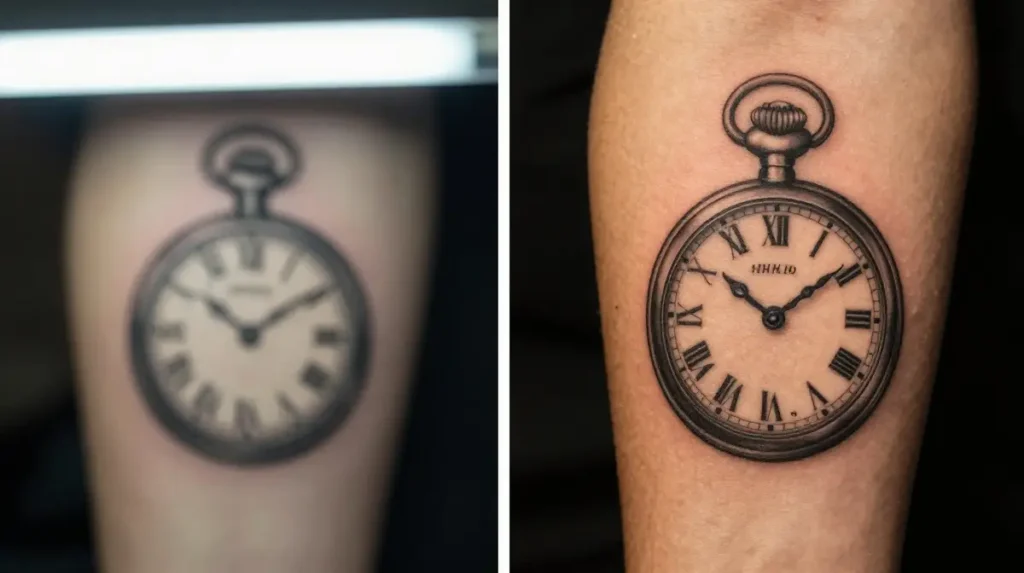
The graveyard of regrettable pocket watch tattoo designs is filled with pieces that were rushed, undersized, or executed by artists mismatched to the style. Sizing is the most common mistake — clients choose designs too small for the level of detail they want and within three years the fine lines have merged into muddy smudges. Rule of thumb: if an artist suggests going bigger, trust them. They’ve seen how skin ages.
Choosing an artist based on price rather than portfolio is the second most destructive mistake. Pocket watch tattoo for men and pocket watch tattoo for women both demand technical investment — there’s no budget shortcut that doesn’t compromise the quality of the work. Placement on high-motion areas — elbows, knees, hands, feet — accelerates ink migration and fading at rates that will frustrate you within years. Finally, neglecting the consultation: walking in with only a vague idea and expecting the artist to build your vision from thin air produces generic results. Arrive with a clear brief, strong references, and genuine engagement. The collaboration that follows will produce something extraordinary.
Frequently Asked Questions
What does a pocket watch tattoo symbolize?
A pocket watch tattoo most commonly symbolizes the passage of time, the preciousness of specific moments, mortality, memory, and the honoring of loved ones. The symbolism of clock tattoos varies by detail — frozen hands suggest a significant frozen moment, open casings suggest transparency and vulnerability, and broken faces often represent irreversible change or loss.
Is a pocket watch tattoo more popular with men or women?
Both. Pocket watch tattoo for men tends toward larger, sleeve-integrated compositions with darker palettes and skull or compass companions. Pocket watch tattoo for women frequently incorporates floral elements, watercolor backgrounds, and fine line detail work. The motif itself transcends gender entirely — it’s the stylistic execution that differs.
What is the best placement for a pocket watch tattoo?
The inner forearm, outer upper arm, thigh, and chest are the most recommended placements per any serious pocket watch tattoo placement guide. These areas offer stable, relatively flat skin with minimal distortion from joint movement and slower rates of UV exposure-related fading compared to hands or feet.
How long does a detailed pocket watch tattoo take to complete?
A single-session simple design might take three to four hours. A detailed clock tattoo sleeve with full background elements, multiple companion motifs, and fine line inner detail can require ten to twenty hours spread across multiple sessions. Realistic planning prevents exhaustion and ensures quality across the entire composition.
Can a pocket watch tattoo be done in fine line style?
Yes — and beautifully so. Fine line tattoo detail produces extraordinarily delicate results on watch faces. However, fine line work requires exceptional aftercare and diligent lifetime sun protection to prevent premature blurring. Discuss longevity expectations openly with your artist before committing to this technique.
Conclusion
Why a Pocket Watch Tattoo Is One of the Most Enduring Decisions You Will Ever Make
Pocket watch tattoos aren’t a phase. They aren’t a trend that peaked in a particular decade and will embarrass you at forty. They’re an ancient conversation between human beings and their awareness of mortality — and that conversation has been ongoing for centuries, from Victorian mourning lockets to the forearms of Brooklyn tattoo collectors today. The motif endures because what it represents — the weight of time, the sanctity of specific moments, the refusal to let important things disappear — is woven into the fabric of what it means to be human.
When you choose a pocket watch tattoo, you choose deliberately. You choose the style that speaks your aesthetic language. You choose the artist whose hands can translate your emotion into line and shadow. You choose the placement that honors the composition’s geometry. You choose the detail — the frozen hands, the Roman numerals, the heirloom scratches — that makes the piece yours and no one else’s. And then you carry it, every day, as a visible commitment to the moments and people that shaped you. That’s not just a tattoo. That’s a testament.
1 Comment