
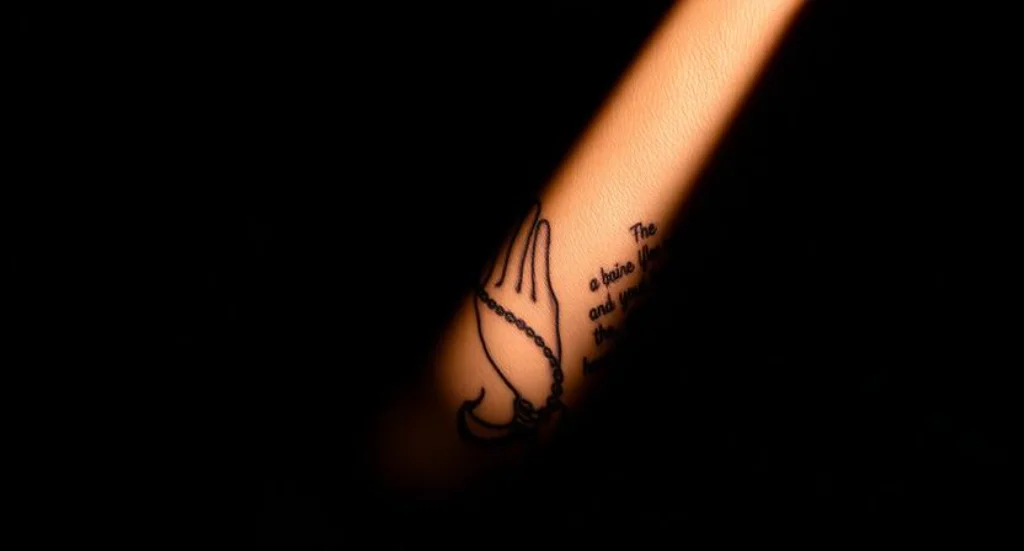
Some tattoo subjects transcend decoration entirely and enter the territory of genuine personal theology. Praying hands tattoos occupy this territory with more authority than almost any other design category available in contemporary tattooing. The joined hands — fingers interlaced, palms pressed, wrists converging — carry a weight of symbolism that cuts across cultural boundaries, denominational distinctions, and personal belief systems simultaneously. Whether the motivation is religious devotion, memorial tribute, spiritual identity, or aesthetic appreciation for one of art history’s most iconic compositions, praying hands tattoos consistently deliver a depth of personal meaning that purely decorative designs cannot approach. This guide explores every dimension of this subject: its historical origins, its technical execution challenges, its style variations, its placement options, and the practical knowledge that turns a meaningful concept into a genuinely great tattoo.
The Ancient Symbolism Behind Praying Hands Tattoos That Still Resonates Deeply
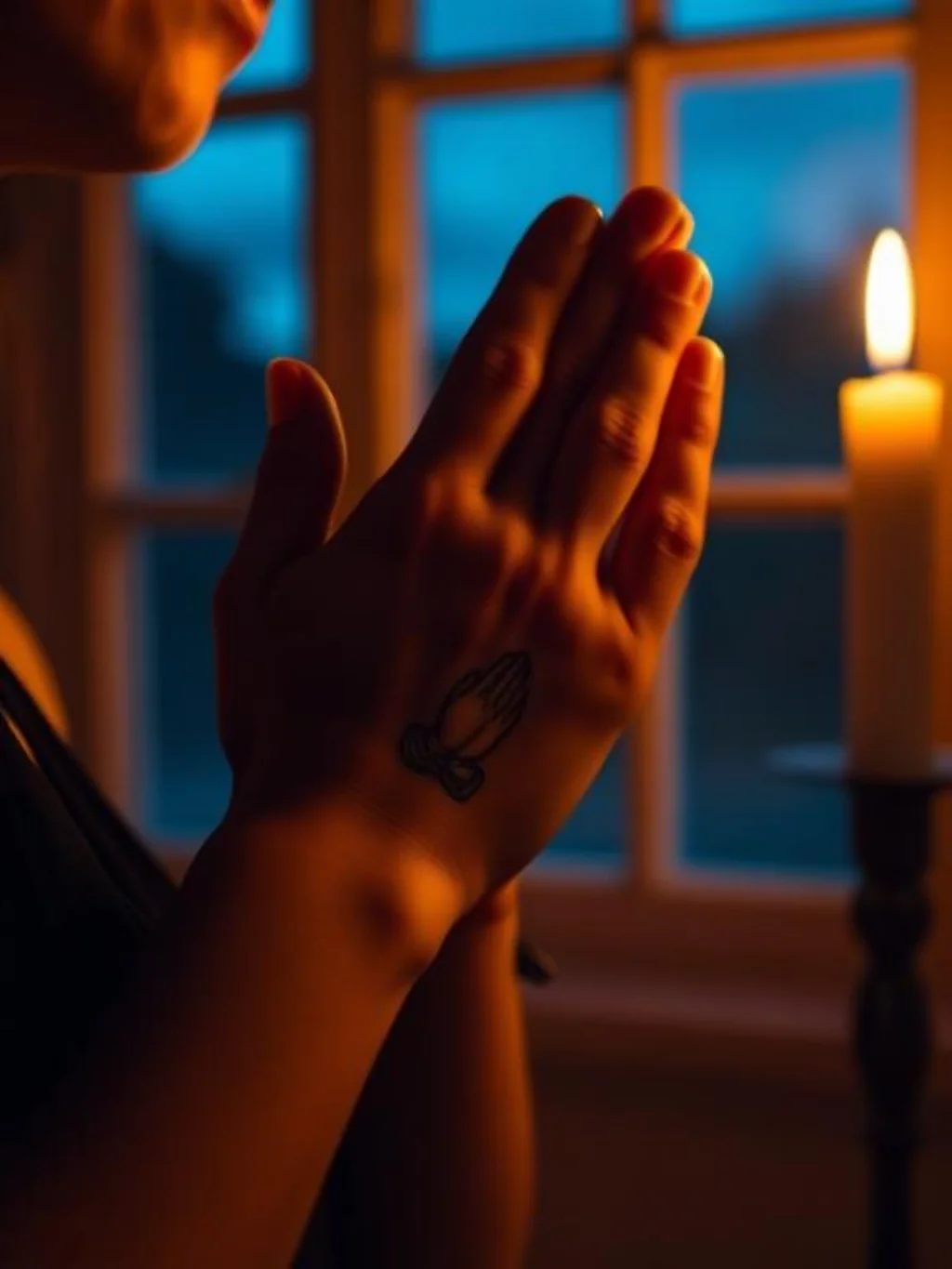
Praying hands tattoo meaning and symbolism reaches back through human history to the earliest expressions of devotional gesture across multiple spiritual traditions. The pressed-palm position appears in ancient Egyptian hieroglyphic art, in Mesopotamian votive figures, in Buddhist mudra hand positions, and throughout the Western Christian iconographic tradition. When the gesture appears in tattoo form, it carries this accumulated history of human reverence into the contemporary cultural moment.
Religious faith tattoo ideas built around praying hands carry specific meaning in the American Christian cultural context where they appear most frequently. The hands represent petition — the physical expression of speaking to a divine presence that cannot be seen. They represent humility — the body’s acknowledgment of something greater than itself. And they represent devotion — the deliberate, repeated choice to approach the sacred rather than simply believe in it abstractly. Prayer and spirituality ink carries all three dimensions simultaneously, which is why the design resonates with people whose specific theological views differ substantially but whose relationship to the gesture’s emotional content aligns completely.
Praying Hands Tattoos Built on the Legacy of Albrecht Dürer’s Sacred Drawing
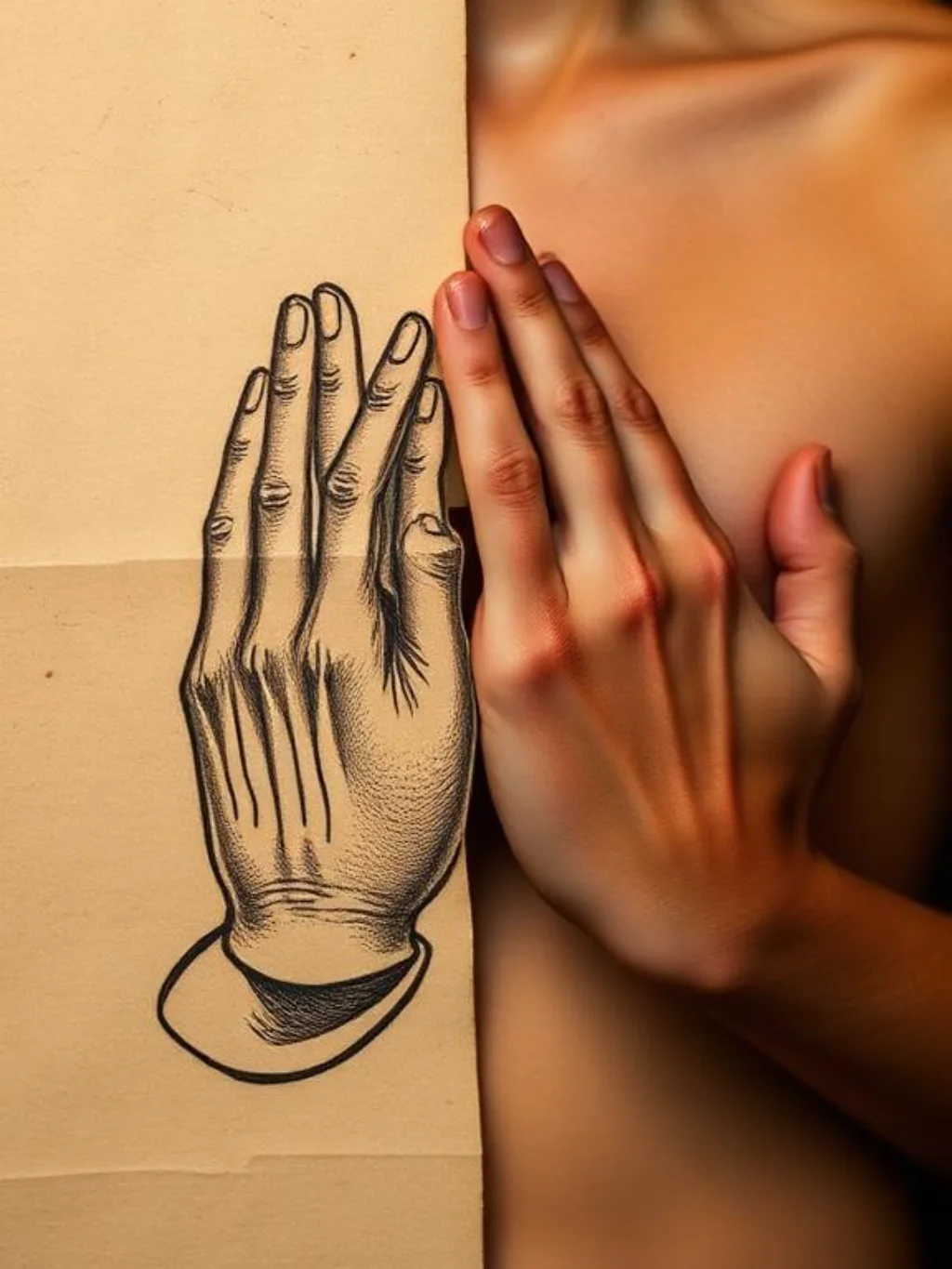
Praying hands tattoo Dürer inspired designs draw from one of the most recognized artworks in Western cultural history. The 1508 study of an apostle’s hands, created by Nuremberg artist Albrecht Dürer praying hands artwork as a preparatory piece for an altarpiece, has become the visual template for nearly every realistic praying hands tattoo executed in the past century. The drawing’s specific characteristics — the precise rendering of skin folds, the exact angle of the finger positions, the subtle foreshortening of the palm — create a compositional standard that the tattoo community has returned to repeatedly across different styles and generations.
Dürer hand study tattoo reference in contemporary tattooing requires understanding that Dürer’s original drawing shows aging, laboring hands — not idealized hands but honest, worked hands with visible character. This specificity is what gives the reference its emotional power. Sacred imagery tattoo designs that faithfully reference this compositional heritage carry an art historical depth that purely invented praying hand compositions often lack. Artists with genuine fine art backgrounds frequently approach Dürer-referenced commissions differently from those working purely from tattoo flash reference, and the quality differential in the final execution can be substantial.
Realism Techniques That Make Praying Hands Tattoos Look Carved From Life
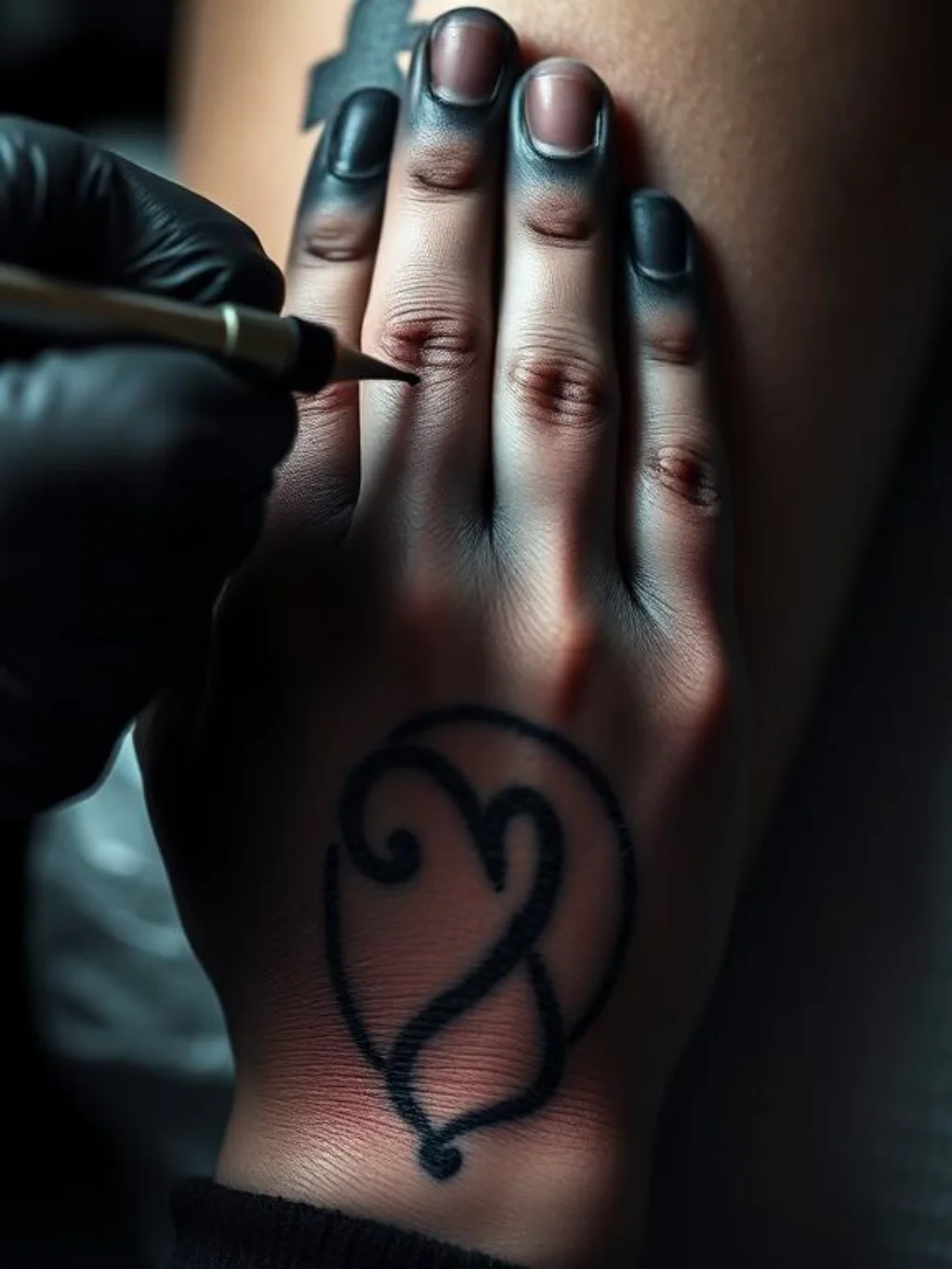
Realistic praying hands tattoo design ideas represent one of the most technically demanding categories in the entire tattooing discipline. The human hand is extraordinarily complex anatomically — the knuckle geometry alone involves overlapping skin folds, visible tendon lines, and bone structure that creates dimensionality across a very small surface area. A realism tattoo technique applied to praying hands must navigate all of this anatomical complexity while also managing the compositional challenge of two hands pressed together, which doubles every technical difficulty.
Finger interlace detail tattoo rendering is where most praying hands realism tattoos either succeed or fail. The interlaced fingers create a series of overlapping forms that require precise understanding of light, shadow, and edge quality to render convincingly. Shading volume hand tattoo method in realism work uses multiple needle techniques — tight magnum shaders for smooth gradient skin tones, curved magnums for subtle value transitions, and single needles for the sharp detail of knuckle creases and nail edges. Praying hands tattoo black and grey shading in the realism category particularly benefits from this multi-needle approach, where the tonal range from deep shadow in the finger valleys to bright highlight on the knuckle peaks creates the three-dimensional illusion that makes great realism tattoos extraordinary.
The Rosary Beads Addition That Transforms a Prayer Into a Complete Visual Narrative
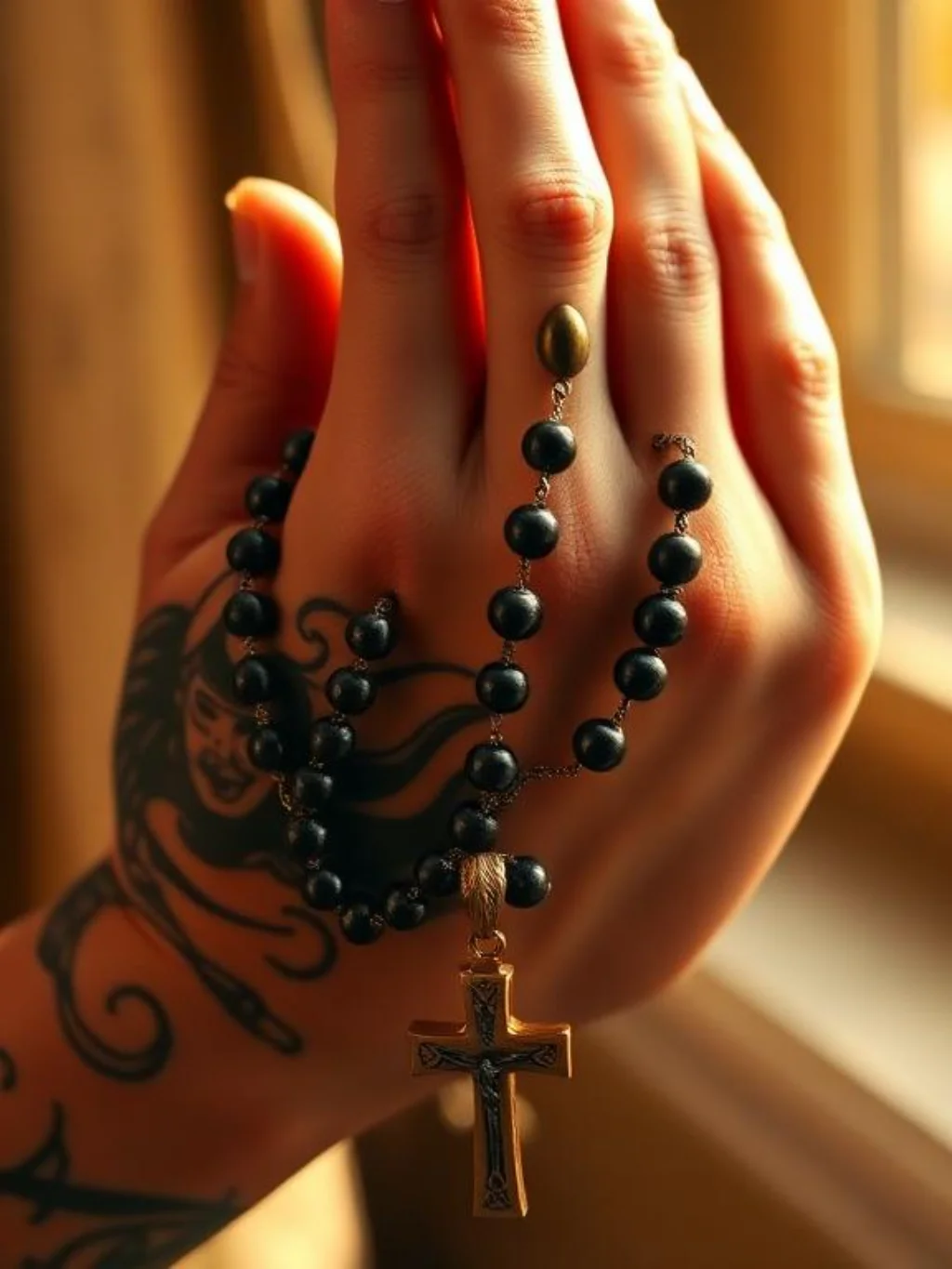
Praying hands tattoo with rosary beads ideas create one of the most compositionally satisfying variations available within this design category. The rosary adds three critical dimensions that the hands alone cannot provide: a narrative element (the devotional practice of rosary prayer), a visual framing element (the chain of beads creating a circular or cascading compositional structure around the hands), and a Catholic specificity that deepens the religious meaning for many wearers.
Rosary bead draping tattoo technique requires careful compositional planning — the beads should drape naturally around and between the hands in a way that suggests gravity and genuine material weight rather than decorative addition. The cross that terminates the rosary serves as a secondary compositional anchor, typically positioned at the lower end of the composition or alongside the hands as a companion element. Catholic rosary symbolism tattoo designs often incorporate specific details that communicate the wearer’s devotional practice — the mysteries prayed, the patron saint represented by a specific medal on the rosary’s center piece, or the specific bead material (wood, crystal, semi-precious stone) that the wearer’s actual rosary uses.
Memorial Praying Hands Tattoos That Keep the Departed Forever Present
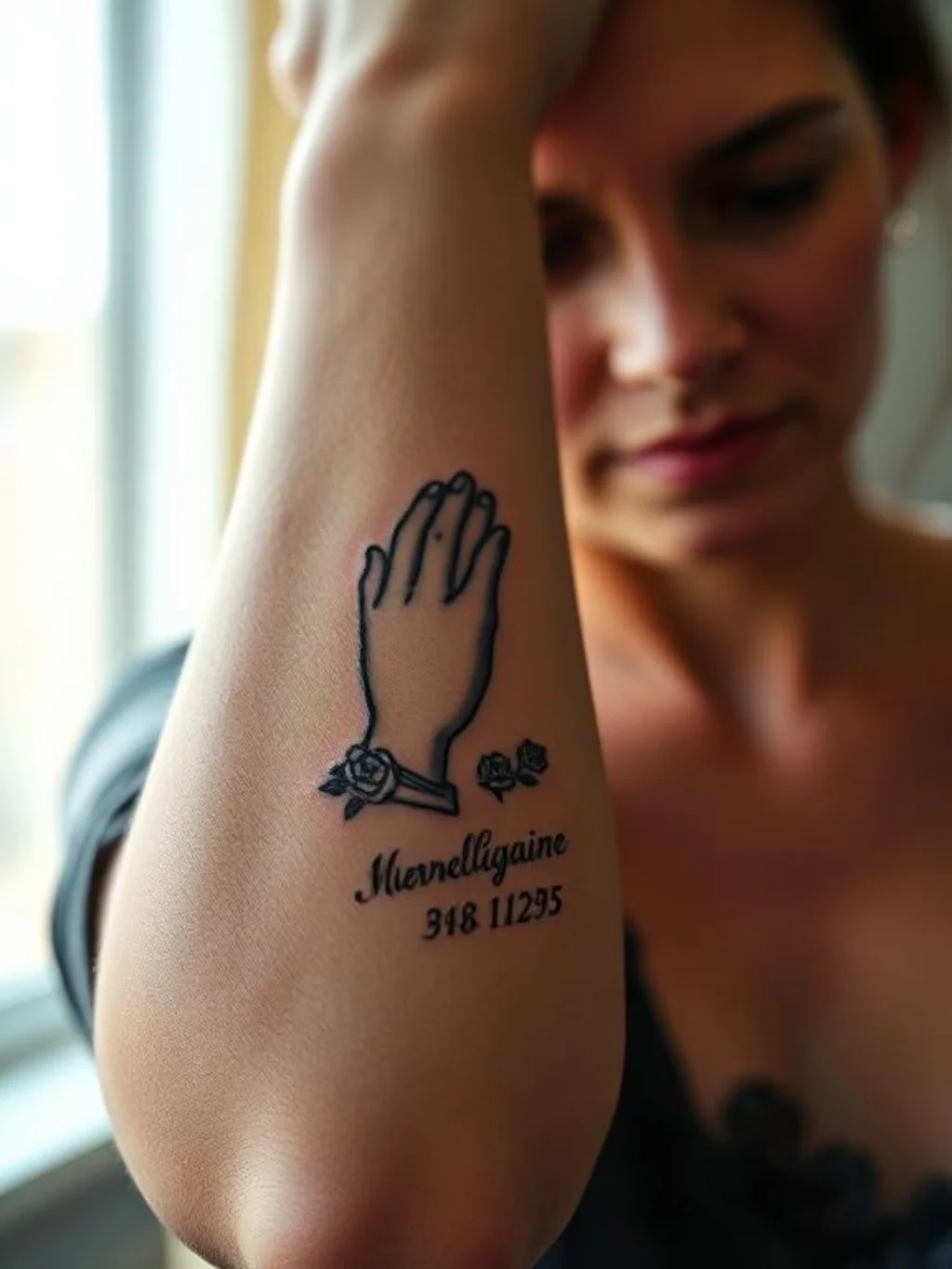
Praying hands memorial tattoo design ideas represent one of the most emotionally significant applications of this subject in contemporary tattooing. When the person being honored was known for their faith, their prayer practice, or their spiritual presence in the family, praying hands become the most natural memorial language available. The tattoo doesn’t just commemorate the person’s existence — it honors the specific spiritual dimension of who they were.
Praying hands tattoo with name and date in memorial context requires thoughtful compositional integration of the text element. The name and dates should feel like part of the composition rather than labels applied to it — incorporated into a banner element below the hands, rendered in script along the wrist line of the composition, or integrated into a cloud or light ray element above the hands. Religious memorial tattoo ideas built around praying hands also frequently incorporate additional elements specific to the departed person’s faith expression: their favorite scripture verse, a flower that held personal significance, or the specific religious iconography associated with their tradition.
Bible Verse and Scripture Pairings That Give Praying Hands Tattoos Their Voice
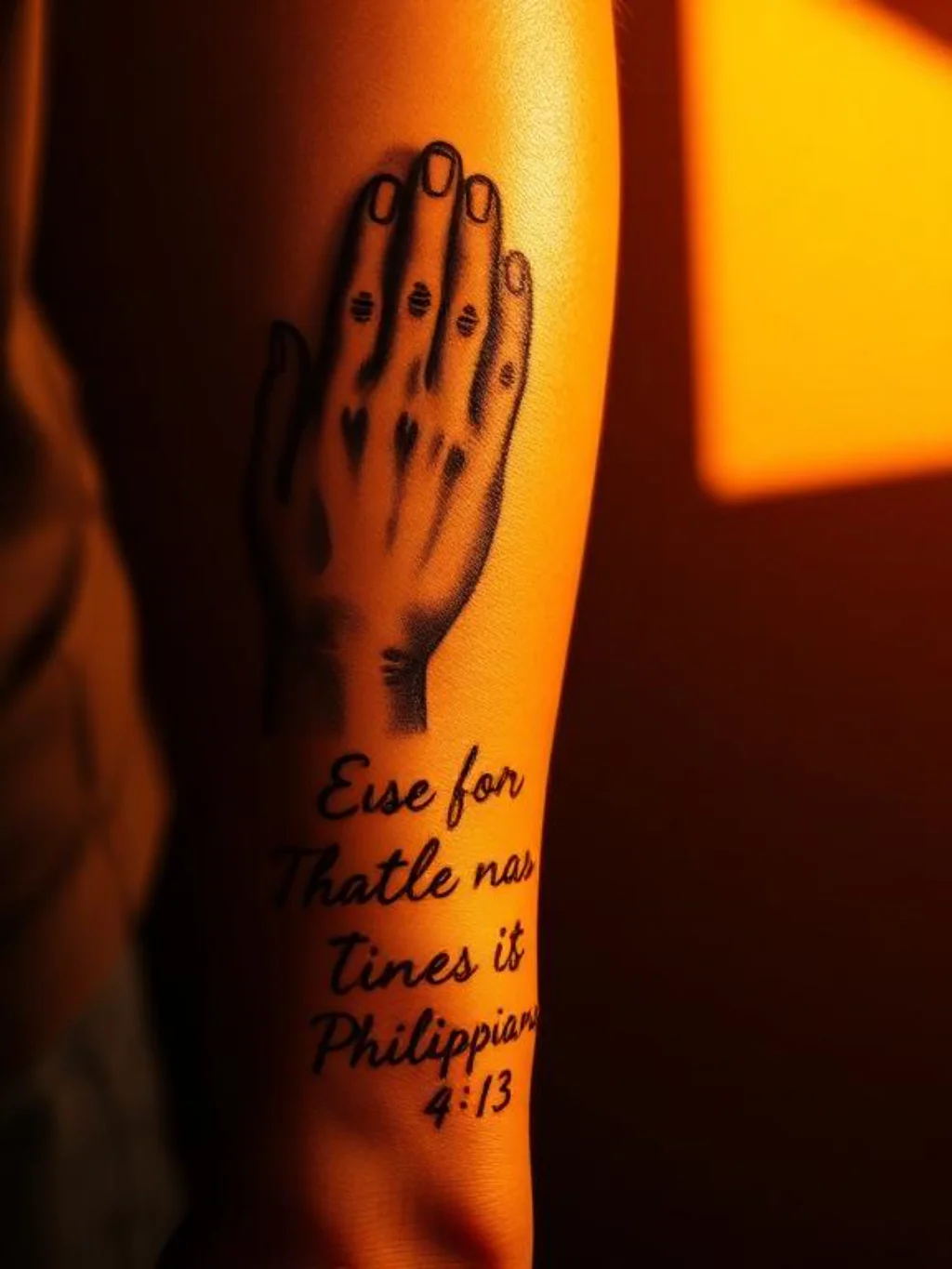
Praying hands tattoo with bible verse ideas add a specific theological voice to what might otherwise remain a general spiritual statement. The scripture selected transforms the design’s meaning from “I believe in prayer” to “I believe in this specific truth communicated through prayer.” This specificity makes the tattoo more personally meaningful and more communicative to others who recognize the verse.
Bible verse script placement tattoo decisions require the same compositional intelligence that any text-and-image tattoo demands. Philippians 4:13 (“I can do all things through Christ who strengthens me”) appears frequently alongside praying hands because its declarative confidence matches the intentionality of the prayerful gesture. Jeremiah 29:11 provides hope context. Psalm 23 provides protection language. Christian heritage tattoo concepts expressed through scripture pairings communicate not just personal faith but connection to a textual tradition that has sustained communities across centuries — a depth of reference that purely visual elements alone cannot achieve.
Praying Hands Tattoos for Men — Bold Placements and Powerful Execution
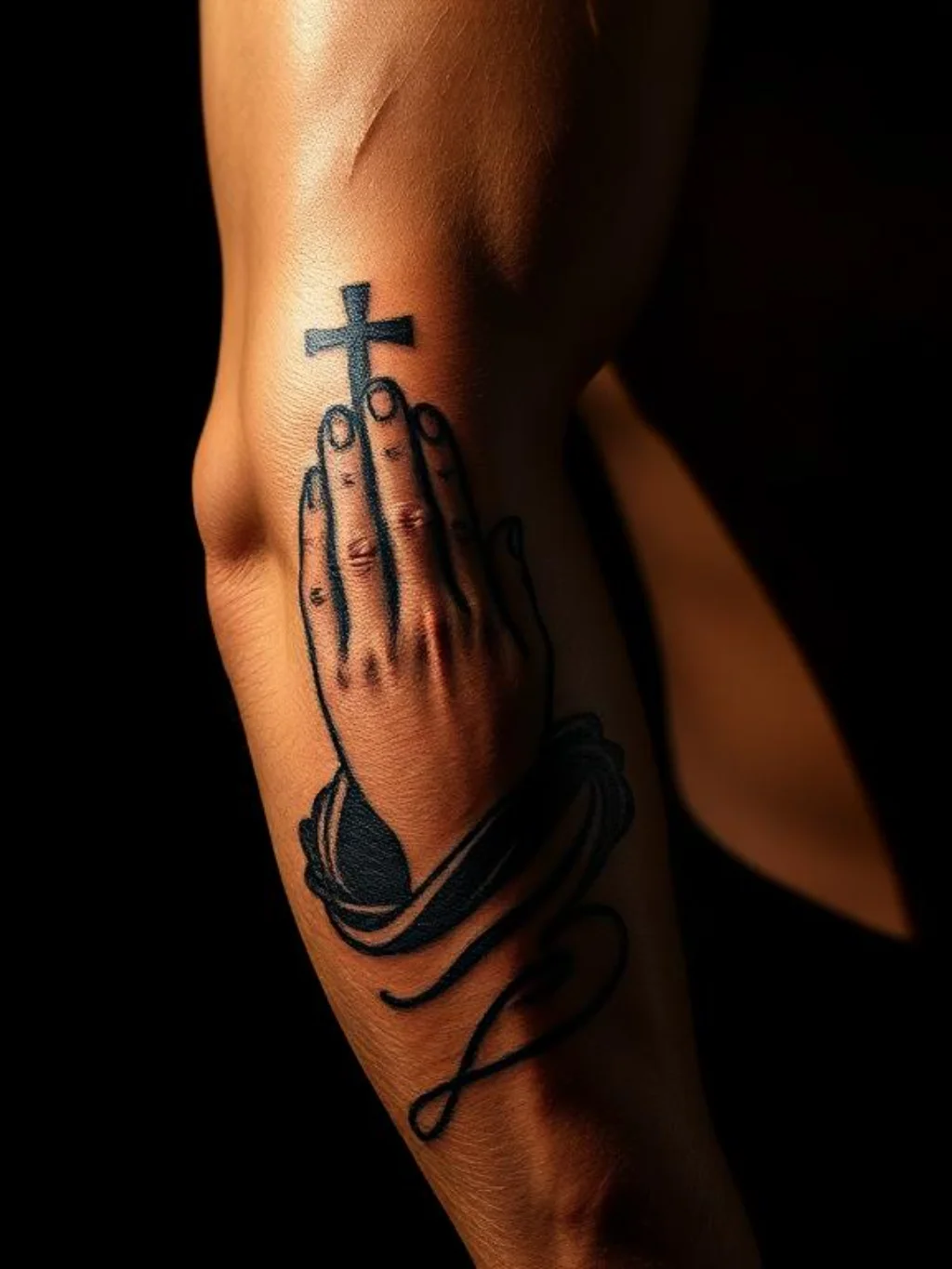
Praying hands tattoo ideas for men on arm represent the most popular gender-specific placement category for this subject, and the reasons extend beyond simple convention. The forearm’s musculature provides both the surface area required for detailed work and the anatomical context — another set of human hands, visible and working — that creates a meaningful dialogue between the tattoo subject and the body it inhabits. A praying hands tattoo on a working man’s forearm communicates something about the relationship between labor and faith.
you may also like this:22 Women’s Shoulder Flower Tattoo Ideas for Elegant Ink
Praying hands tattoo men in the chest placement — particularly the chest or upper arm — carry the physical authority that the subject deserves. Traditional praying hands tattoo style ideas that appear most frequently on male clients tend toward the bolder, more graphic execution of American traditional or neo-traditional tattooing: heavier line weights, more saturated blacks, less reliance on the subtle tonal gradation of photorealistic work. This bold execution style actually serves the subject’s symbolic weight well — the graphic confidence of heavy black line work communicates conviction in a way that delicate fine-line execution sometimes doesn’t.
Delicate Praying Hands Tattoos for Women With Refined Feminine Detail
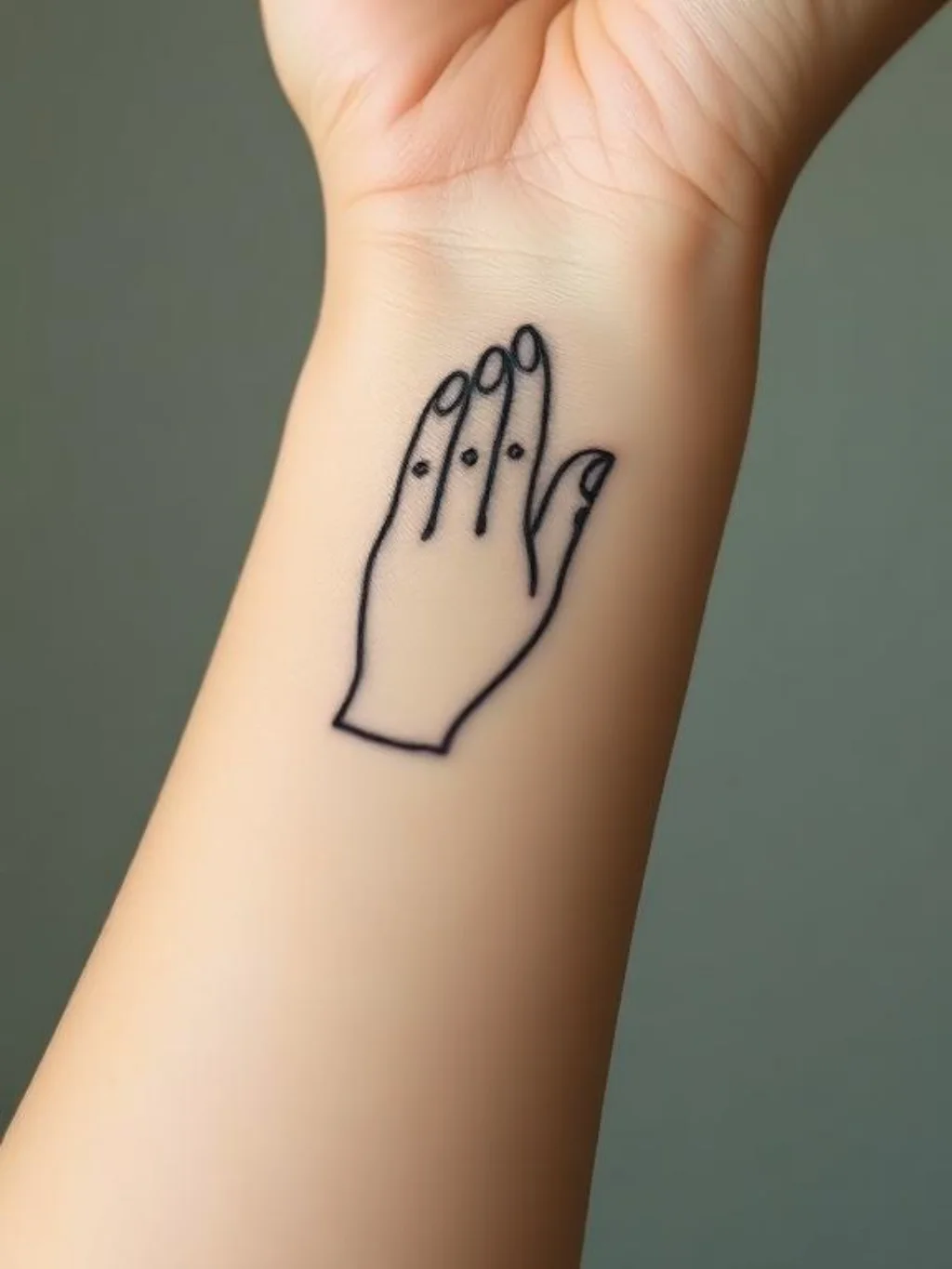
Small praying hands tattoo ideas for women consistently favor the fine-line register that has become the dominant aesthetic preference in women’s tattooing over the past decade. A praying hands composition rendered in hairline ink — the hand forms suggested through the most delicate possible line weights with minimal shading — achieves a quality of quiet reverence that bolder treatments don’t reach. The restraint communicates something specific: faith as a private, intimate experience rather than a public declaration.
Praying hands tattoo women in floral combination represent the most popular design direction in this category — praying hands tattoo with flowers design ideas that integrate lily stems, rose branches, wildflowers, or botanical clusters around the praying hand composition add a dimension of natural beauty and symbolic depth (renewal, purity, grace) that complements the spiritual content of the hands themselves. Faith honor tattoo designs built on this floral combination frequently appear on the inner forearm, wrist, or collarbone — placements where the delicacy of fine-line execution reads most clearly against the skin.
The Chest and Sternum — Sacred Placement for a Sacred Tattoo Subject
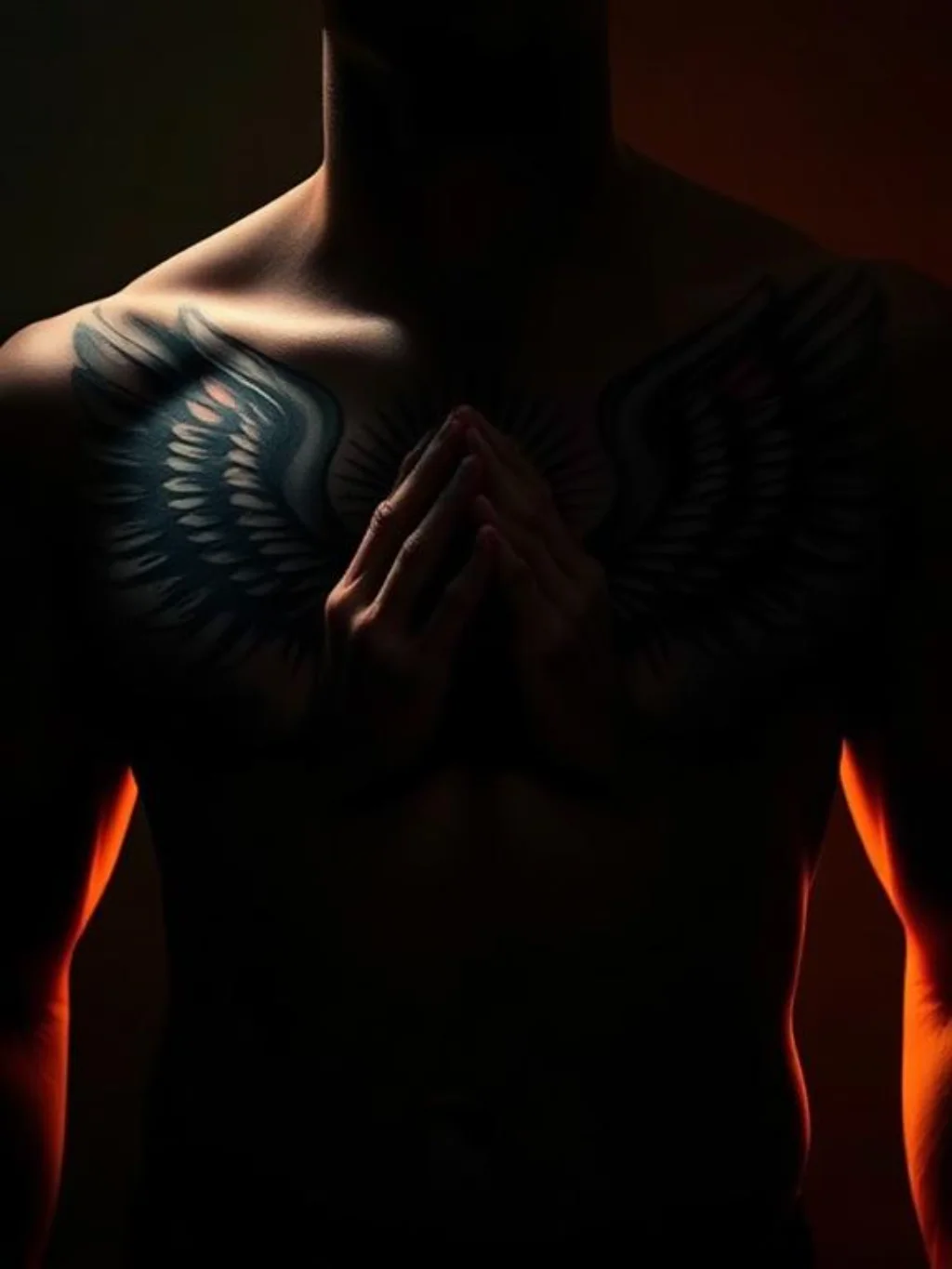
Praying hands tattoo ideas for chest placement leverage the most symbolically resonant location on the human body for a devotional design. The chest position places the praying hands directly over the heart — the organ most associated across cultures with emotional truth, spiritual depth, and core identity. This positional symbolism reinforces the tattoo’s meaning before anyone reads a single element of the design itself.
Chest sternum praying hands placement creates specific compositional demands. The sternum’s vertical axis suits a vertically oriented composition — hands oriented with fingers pointing upward work naturally in this space, while a horizontal composition would fight the sternum’s architectural direction. Praying hands tattoo chest designs that include additional elements — scripture above, a cross below, roses on either side — can span from shoulder to shoulder in a full chest piece that reads as an altar piece rather than a single tattoo element. This scale allows the level of detail that the subject’s symbolic importance arguably demands.
Forearm and Inner Arm Praying Hands Tattoos That Stay Visible and Meaningful
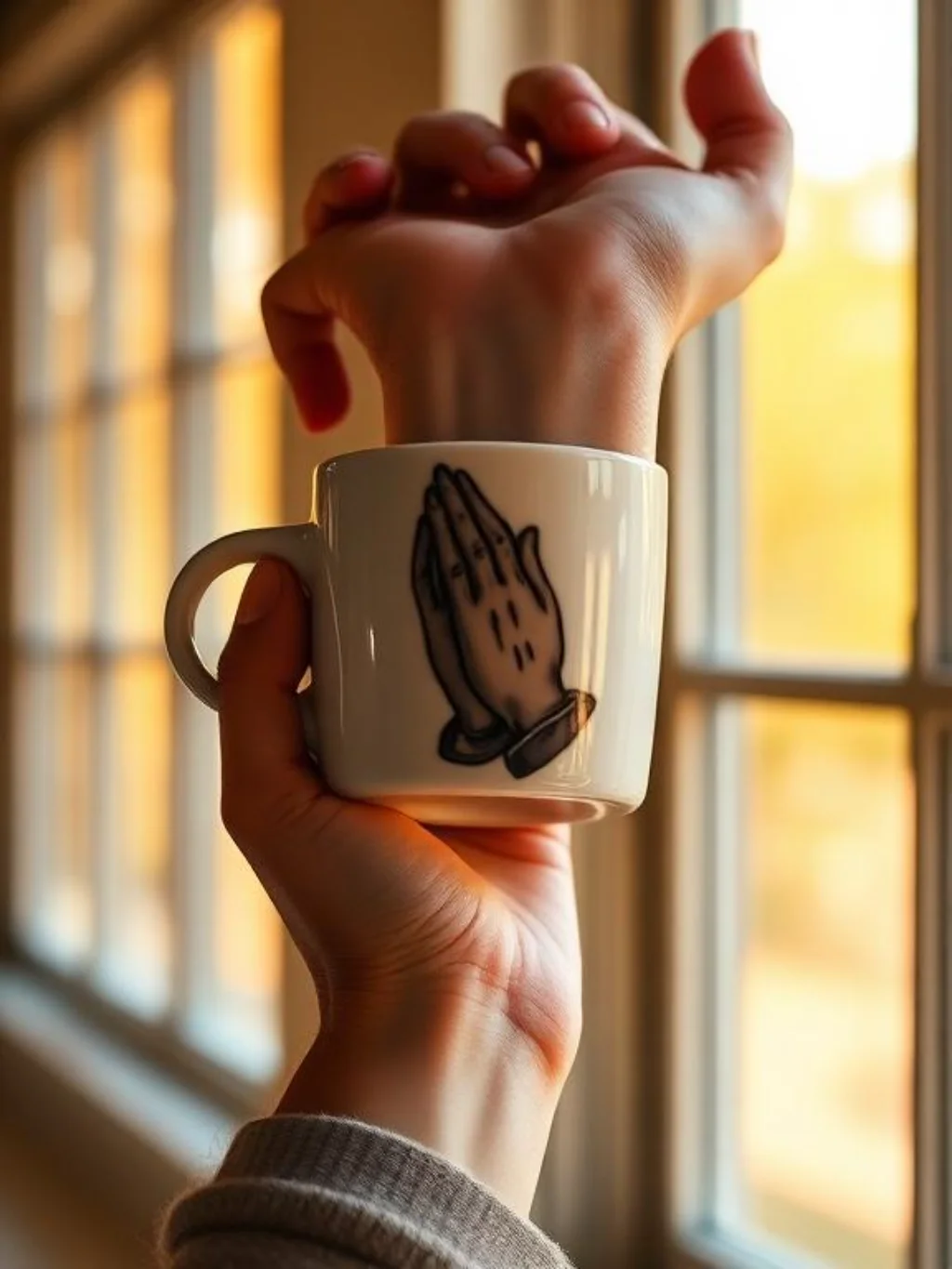
Praying hands tattoo forearm placement remains the single most requested location for this subject because it combines maximum visibility with genuine accessibility — the forearm is easily displayed, easily referenced personally, and easily shared with others. The design lives in the daily visual field of both the wearer and everyone they interact with, making the tattoo’s devotional statement consistently present rather than occasionally revealed.
Inner forearm praying hands tattoo scale considerations should account for the forearm’s narrowing toward the wrist — a composition that fits comfortably at mid-forearm may feel crowded as it approaches the wrist’s reduced width. Most experienced artists recommend a primary design width of 2.5 to 4 inches for forearm praying hands tattoos, leaving adequate visual breathing room on either side of the composition. Praying hands tattoo ideas for men on arm in the upper arm location provide more surface area for larger-scale realism work, while the forearm suits the medium-scale, highly detailed work that this subject rewards most.
Cross Wings and Divine Light — Elements That Complete the Prayerful Composition
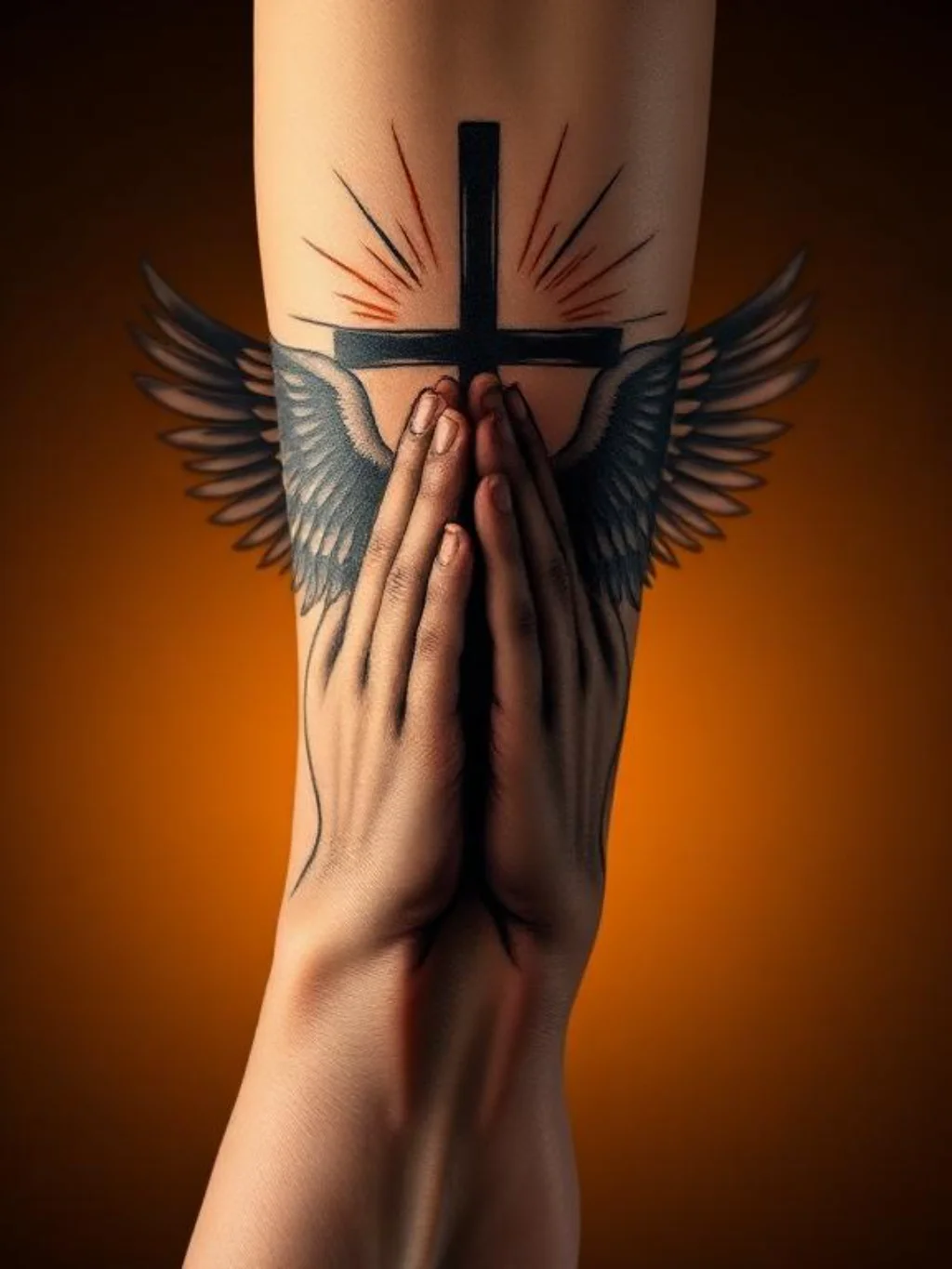
Praying hands tattoo with cross and wings creates one of the most compositionally complete and symbolically layered versions of this design. The cross above or behind the hands provides theological context — the specific Christian redemptive framework within which the prayer occurs. The wings, descending or enfolding from above the composition, add the protective, divine-presence dimension that the cross’s vertical axis alone doesn’t fully communicate.
Cloud and light ray background tattoo behind praying hands extends the composition vertically, providing a contextual environment for the gesture that transforms a floating hand composition into a complete scene. The light rays — emanating from a point above the hands in the traditional iconographic convention — communicate divine response to the prayer being offered, completing the devotional narrative with a visible representation of what the hands reach toward. Praying hands tattoo with wings specifically designed as memorial elements use the wing detail to reference the departed’s transformation — the physical person gone, their presence translated into something that hovers protectively over those left behind.
Black and Grey Praying Hands Tattoos With a Depth That Color Cannot Match
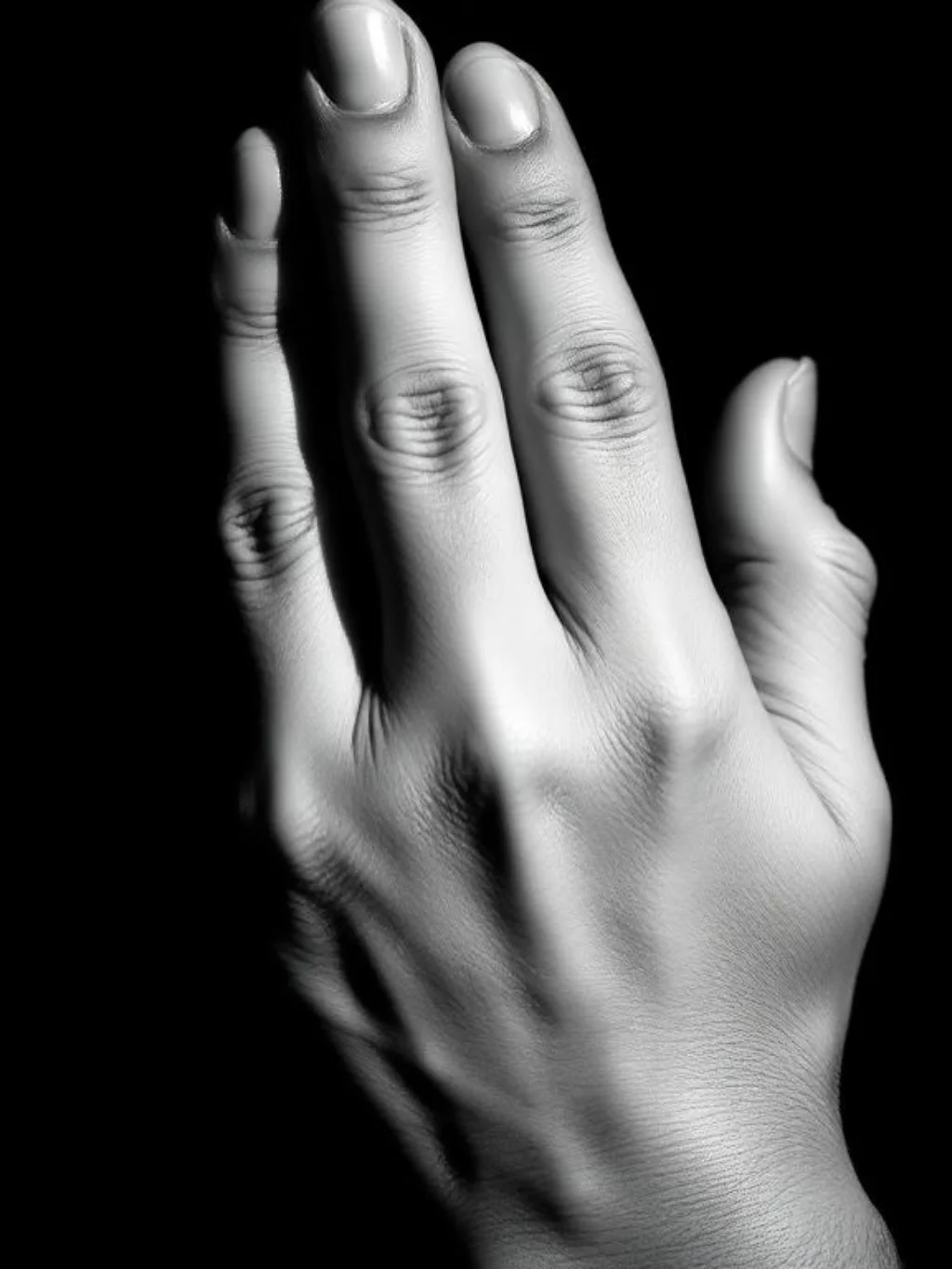
Praying hands tattoo black and grey work occupies a special position within this design category because the tonal discipline of the style perfectly suits the subject’s emotional gravity. Restraint and gravity are both properties of black and grey tattooing and properties of genuine devotional experience — the aesthetic match is nearly perfect. Praying hands tattoo black and grey shading in skilled hands produces tonal ranges from near-white highlights on the knuckle peaks to near-black shadow in the deepest finger valleys, with every intermediate value between serving the three-dimensional illusion.
Blackwork tattoo method applied to praying hands takes the tonal restraint of black and grey to its logical conclusion — eliminating grey tones entirely in favor of a design built exclusively on the relationship between saturated black ink and negative skin space. This approach produces graphic rather than photographic results, which suits simplified or stylized praying hand compositions more than realistic ones but creates extraordinarily powerful visual impact through its contrast. Praying hands tattoo religious designs in pure blackwork, particularly those incorporating bold cross or rosary elements, carry a graphic authority that colored tattoos rarely achieve at equivalent scale.
Watercolor Praying Hands Designs That Soften the Sacred Into Painterly Beauty
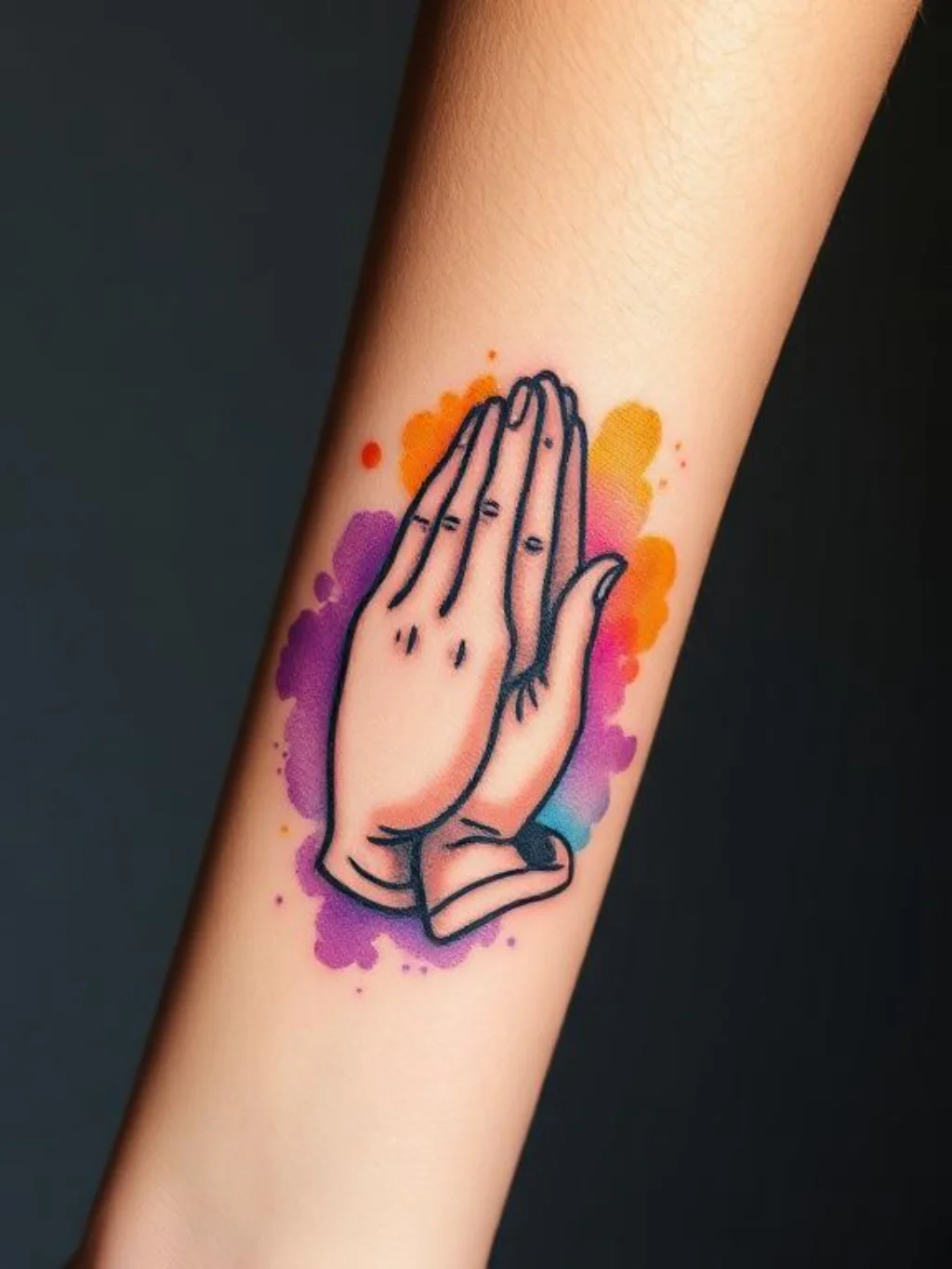
Praying hands tattoo watercolor designs apply the transparent, bleed-edge aesthetic of watercolor painting to a subject whose conventional execution involves the graphic control of line-and-fill work. The juxtaposition — spiritual seriousness rendered in the most playful and luminous of tattoo styles — creates a tension that many wearers find precisely expressive of their relationship to faith: something deeply felt but lightly held, serious in its essence but joyful in its expression.
Watercolor tattoo style applied to praying hands typically uses a black line under-drawing of the hands themselves — providing the compositional clarity and edge definition that the subject requires — with watercolor wash applied around, behind, and sometimes within the line work. Praying hands tattoo watercolor compositions frequently incorporate abstract color fields in blues, purples, and warm golds that evoke stained glass, ecclesiastical art, and the chromatic vocabulary of sacred spaces without explicitly reproducing any of them. The color washes create an atmospheric context for the hands that realistic or traditional styles cannot achieve.
Traditional and Neo Traditional Praying Hands With Bold Lines and Rich Color
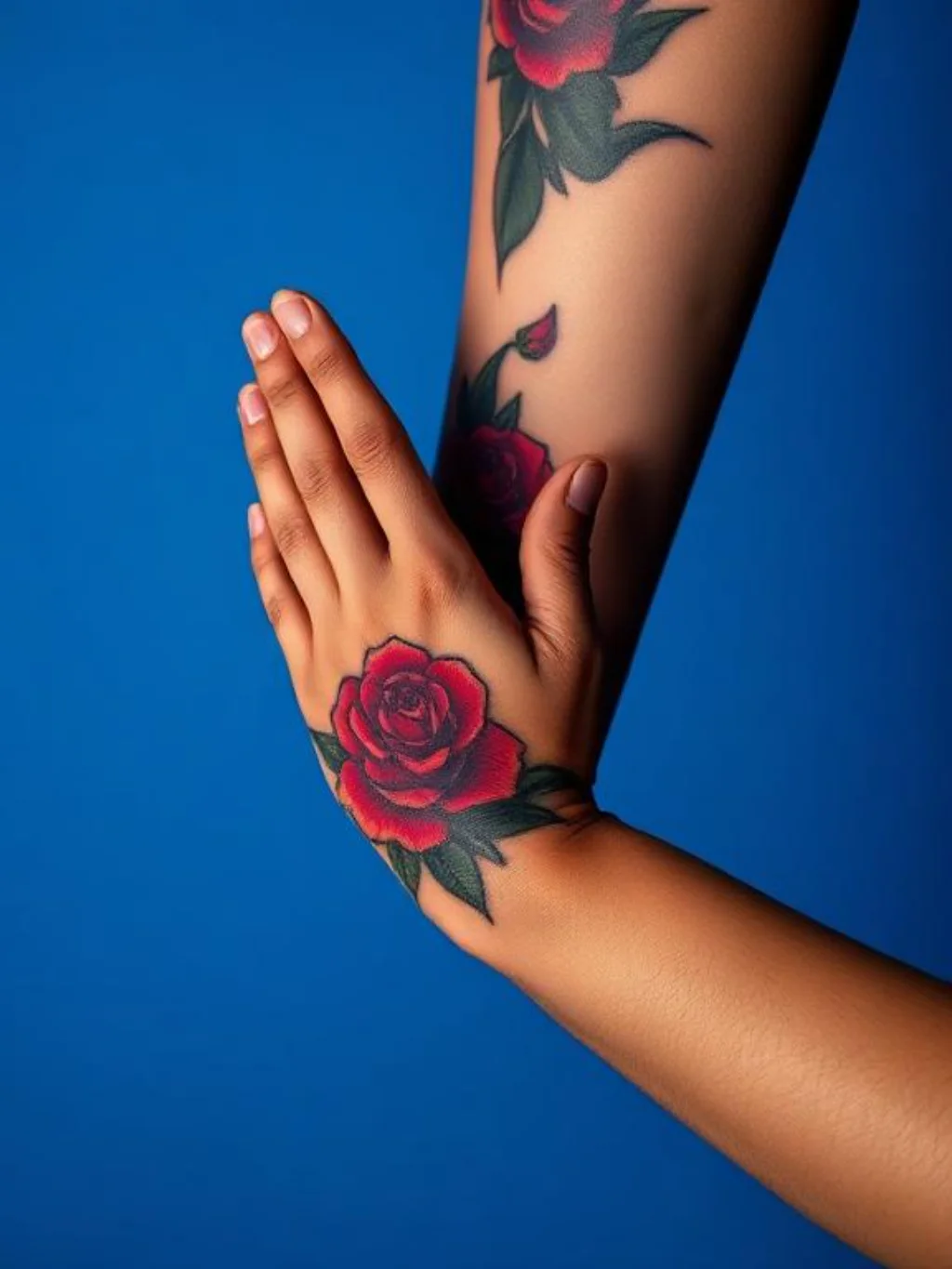
Traditional praying hands tattoo style ideas draw from the American traditional tattooing heritage established by artists like Sailor Jerry religious tattoo tradition — bold outlines, limited color palettes of red, yellow, green, and black, and iconographic simplicity that reads clearly at distance and maintains its integrity over decades of skin aging. In this style, praying hands become graphic symbols rather than realistic renderings, their meaning communicated through compositional convention rather than anatomical accuracy.
Neo traditional tattoo style applied to praying hands expands the traditional framework with a wider color palette, more sophisticated shading, and increased compositional complexity while maintaining the bold line quality that ensures longevity. A neo traditional praying hands composition might feature hands with Art Nouveau-influenced decorative detail on the sleeve area of the depicted wrist, flowers integrated into the composition with naturalistic botanical detail, and a color palette that moves beyond traditional’s limited primary tones into the jewel-tone range. Faith based ink ideas expressed through neo traditional style communicate heritage and contemporary sophistication simultaneously.
Dove and Peace Symbols Combined With Praying Hands for Layered Spiritual Meaning
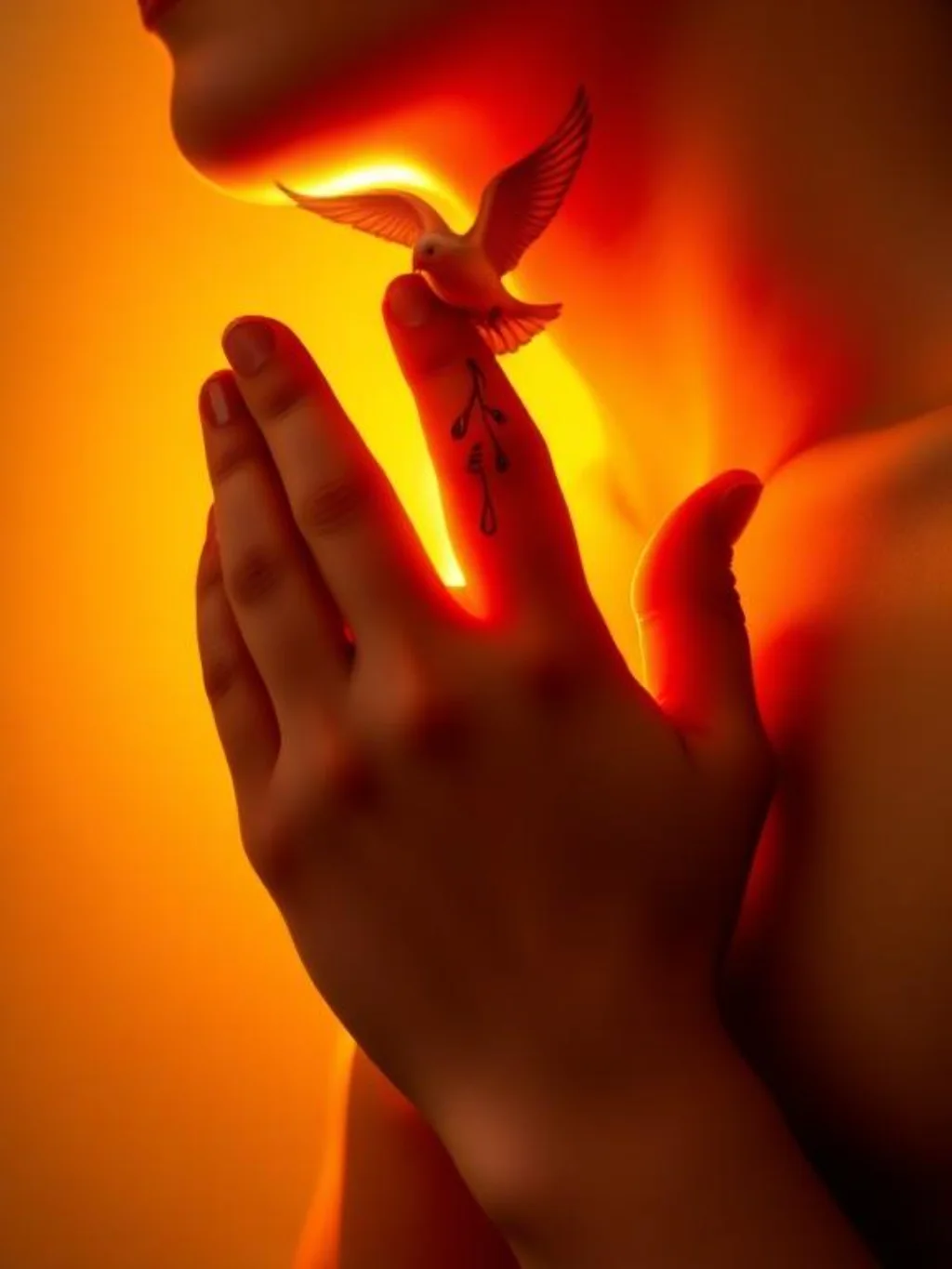
Praying hands tattoo with dove symbolism creates one of the most spiritually complete compositions available within this design category. The dove in Christian iconography represents the Holy Spirit — the active, present dimension of divine engagement with human experience. Positioned above or descending toward praying hands, the dove transforms the composition from a human gesture of address into a visual representation of divine response: prayer as conversation rather than monologue.
Divine connection tattoo ideas built on the dove-and-hands combination also access the broader cultural symbolism of the dove as a peace emblem — making the composition meaningful to wearers whose spiritual orientation may not align precisely with Christian theology but who respond to the dove’s more general association with peace, hope, and spiritual aspiration. Praying hands tattoo with dove symbolism designs range from the photorealistic — a precisely rendered bird in anatomically correct detail descending toward carefully drawn hands — to the schematic, where a simplified dove outline in flight becomes a graphic element within a more stylized composition.
Small and Minimalist Praying Hands Tattoos That Carry Maximum Symbolic Weight
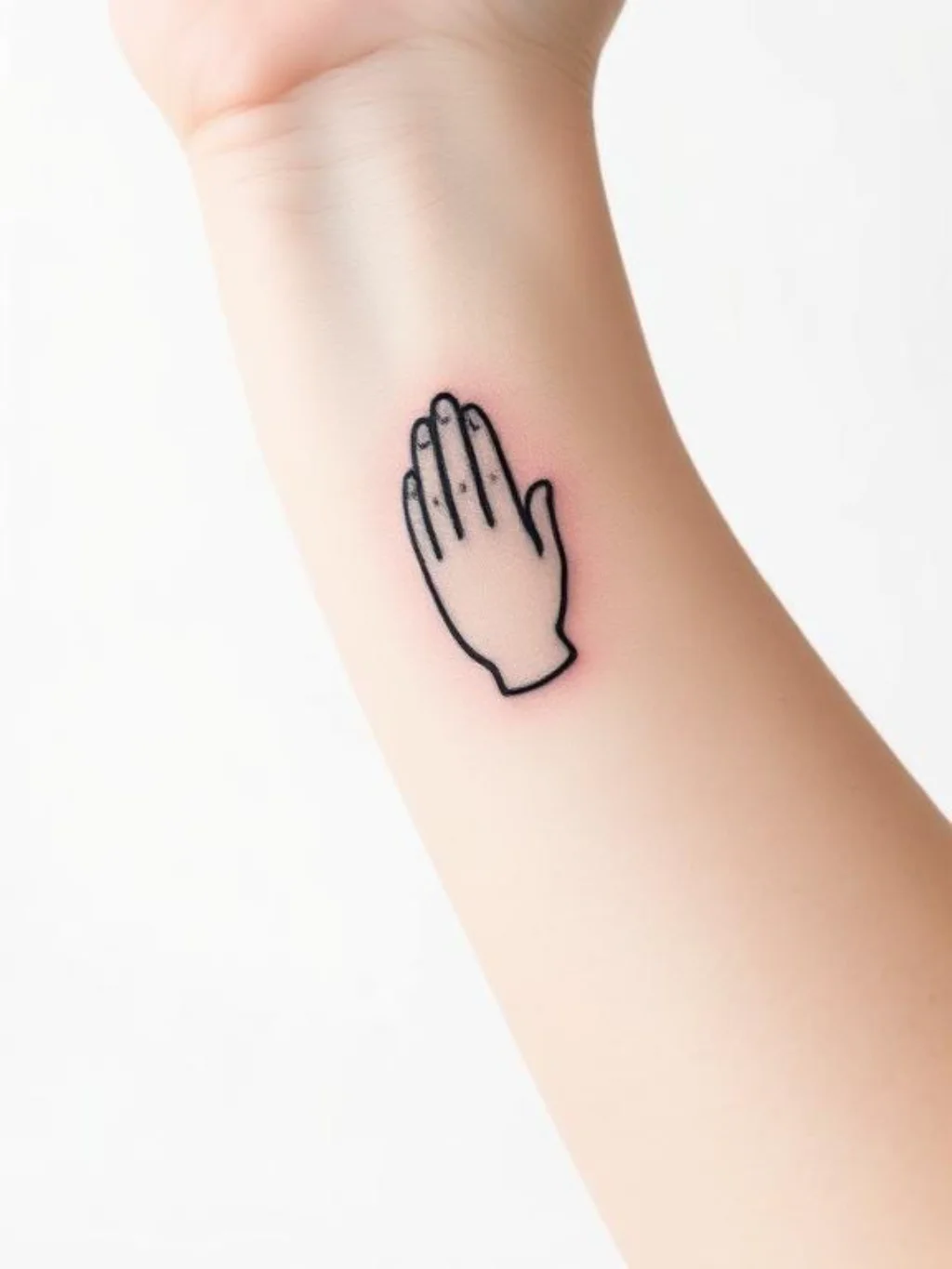
Small praying hands tattoo ideas for women and men who prefer discretion or simplicity demonstrate the most important truth about the design category: the subject’s symbolic power doesn’t diminish with scale. A praying hands tattoo small rendering — perhaps 1.5 to 2.5 inches at its longest dimension — on a wrist, ankle, or behind the ear communicates the same devotional content as a full chest piece. The miniaturization changes the visual register from statement to secret, but the meaning remains intact.
Minimalist tattoo movement applied to praying hands reduces the design to its essential graphic components — the silhouette of the joined hands, perhaps with a single line suggesting the wrist — and relies on that reduction to generate its emotional impact through the viewer’s mental completion of the form. Praying hands tattoo simple designs in the minimalist register work best with artists who understand that simplicity in tattooing requires more precision than complexity — there’s nowhere to hide when a design uses only three lines, so each line must be perfect.
Floral Additions to Praying Hands Tattoos That Speak of Life Growth and Grace
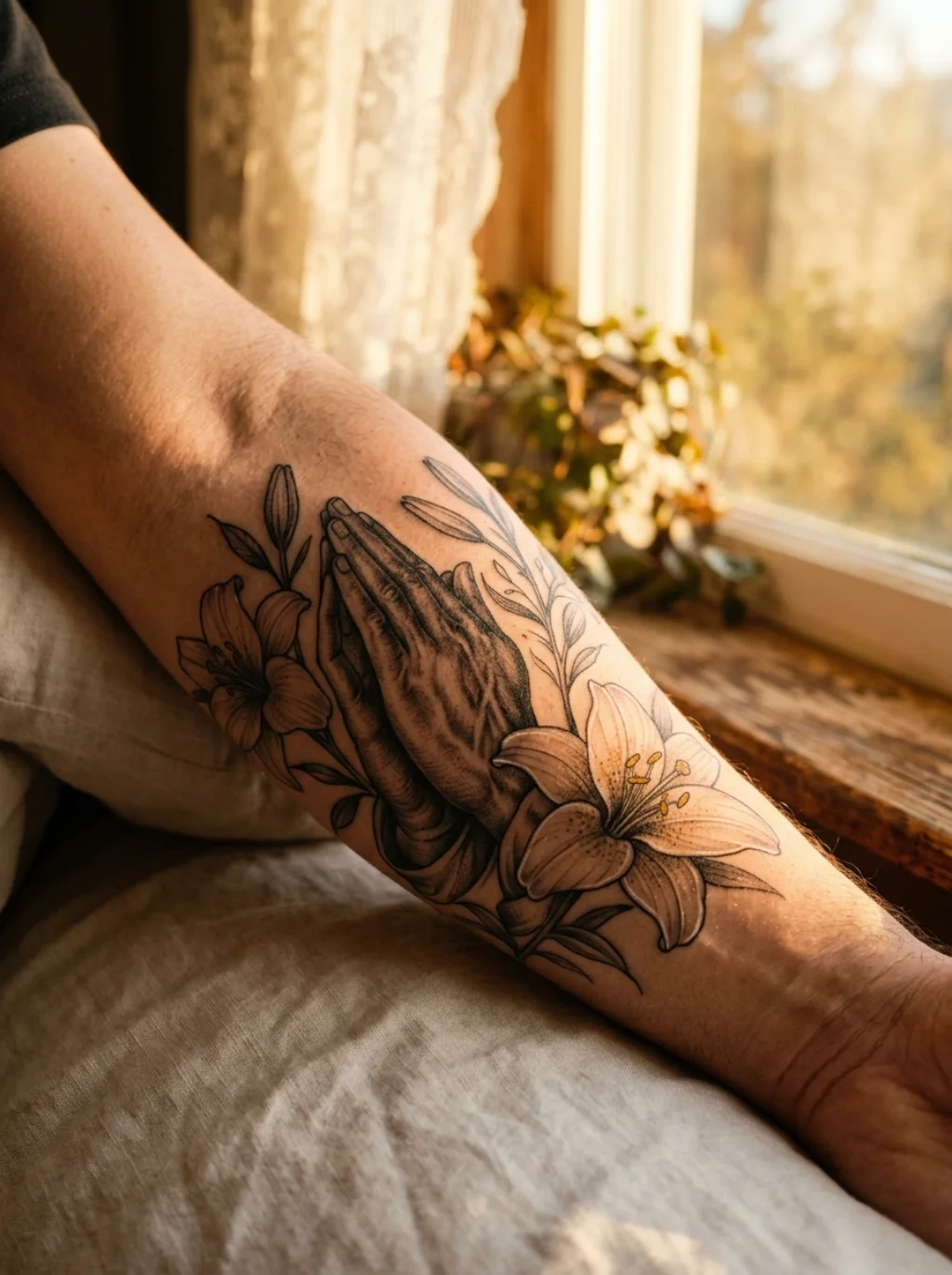
Praying hands tattoo with flowers design ideas represent the most consistently popular compositional variation within this design category, and the reason is both aesthetic and symbolic. Flowers add softness, color, and organic movement to a composition built on the rigid geometry of joined hands. Symbolically, different flower species add specific meanings — roses for love and devotion, lilies for purity and resurrection, sunflowers for faith and loyalty, forget-me-nots for remembrance in memorial contexts.
Lily flower praying hands combination creates perhaps the most symbolically coherent floral pairing — the Easter lily’s association with resurrection and purity in Christian tradition aligns precisely with the prayerful devotional content of the hands themselves. Praying hands tattoo with flowers in the botanical illustration style, where each petal and leaf is rendered with naturalistic accuracy, produces the most visually sophisticated results, but simplified floral additions in fine-line or traditional styles serve the composition effectively at smaller scales where botanical detail would blur into illegibility.
The Sleeve Concept Built Around Praying Hands as the Spiritual Anchor Piece
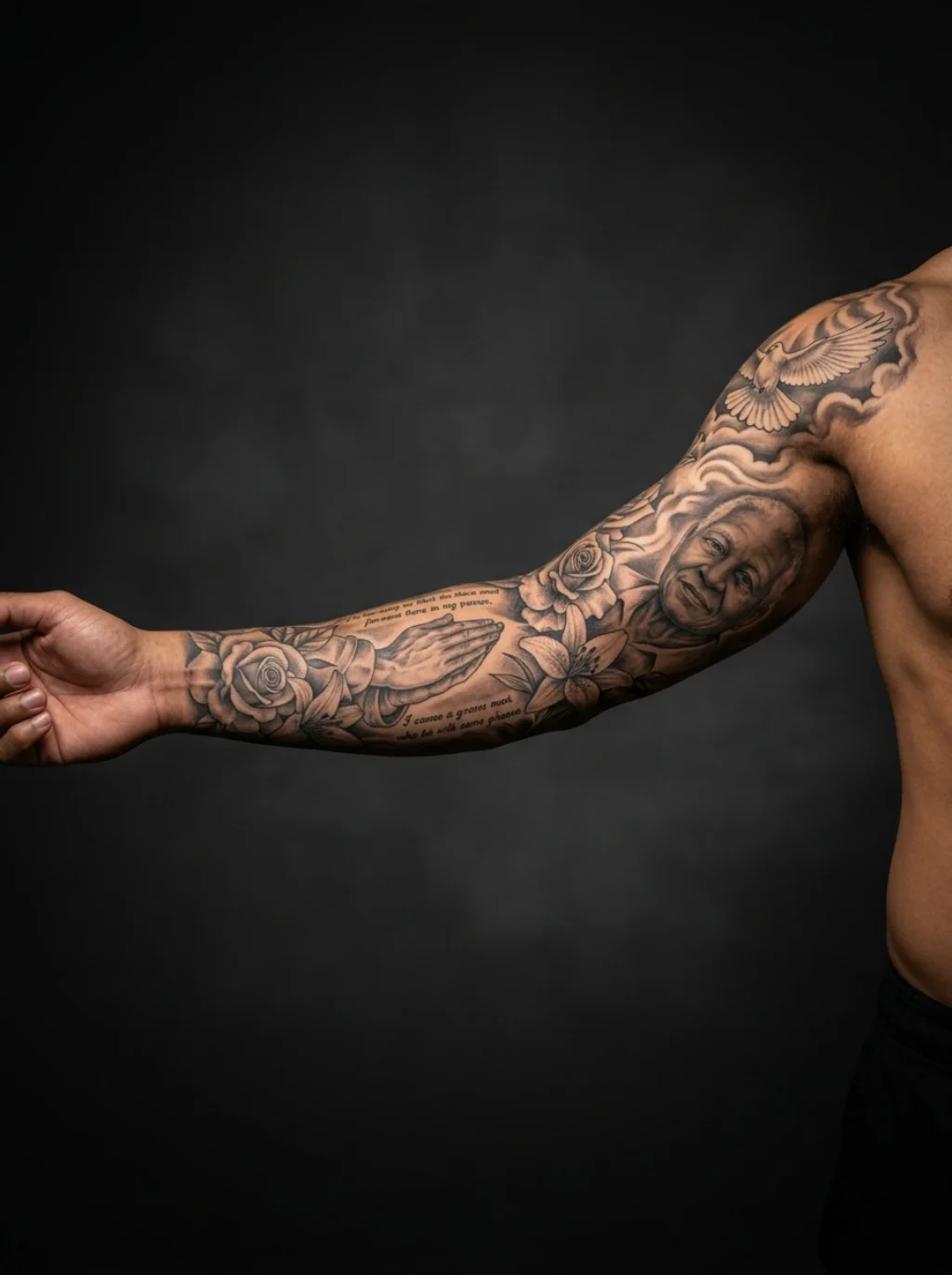
Praying hands tattoo sleeve concepts that use the praying hands composition as the primary anchor element demonstrate how a single deeply meaningful subject can organize a complex multi-element tattoo program across an entire arm. The praying hands occupy the prime visual position — typically the inner forearm in high visibility — while surrounding elements build a complete spiritual narrative: scripture verses, memorial dates and names, symbolic imagery from the wearer’s faith tradition, portrait elements of significant people.
A well-designed praying hands tattoo sleeve functions less like a collection of separate tattoos and more like an illustrated personal theology — a visual statement of the wearer’s spiritual biography assembled around the devotional gesture that anchors it. Worship themed body art programs of this scope require extensive consultation time, a coherent design vision agreed upon before any work begins, and ideally a single artist who manages the full program’s compositional coherence across multiple sessions. The result, when well executed, is among the most personally meaningful and visually impressive outcomes available in the entire tattooing discipline.
Matching and Family Praying Hands Tattoos Shared Across Generations
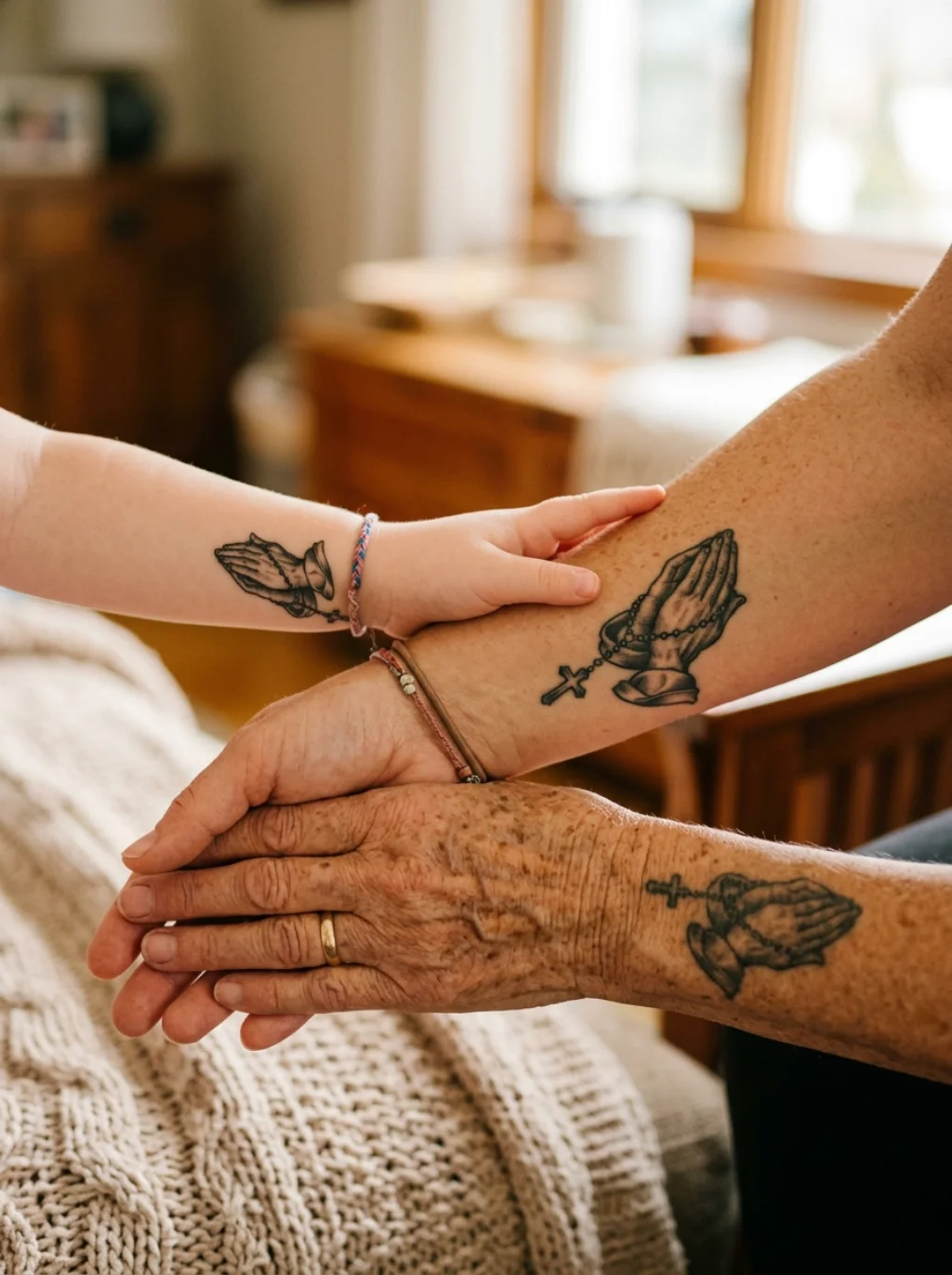
Praying hands tattoo with name elements shared across family members create a devotional bond expressed in permanent ink — connecting siblings, parents and children, or multiple generations through a shared visual commitment. Family faith based ink ideas built on matching praying hands designs communicate the shared spiritual inheritance that family faith represents: the prayers offered for each other, the religious tradition passed from generation to generation, the devotional practice that unites family members who may live geographically dispersed.
The most moving matching praying hands tattoos involve designs where each family member’s tattoo incorporates the others’ names — so that each individual carries not just their own devotional commitment but visible acknowledgment of the people they pray for and with. Family bond tattoo designs in this format create a network of mutual acknowledgment that no single individual tattoo can produce. When gathered together, the matching designs form a complete statement; separated by distance, each piece remains individually meaningful while implying the larger whole.
Choosing the Right Artist Whose Skill Can Render Hands With Genuine Mastery
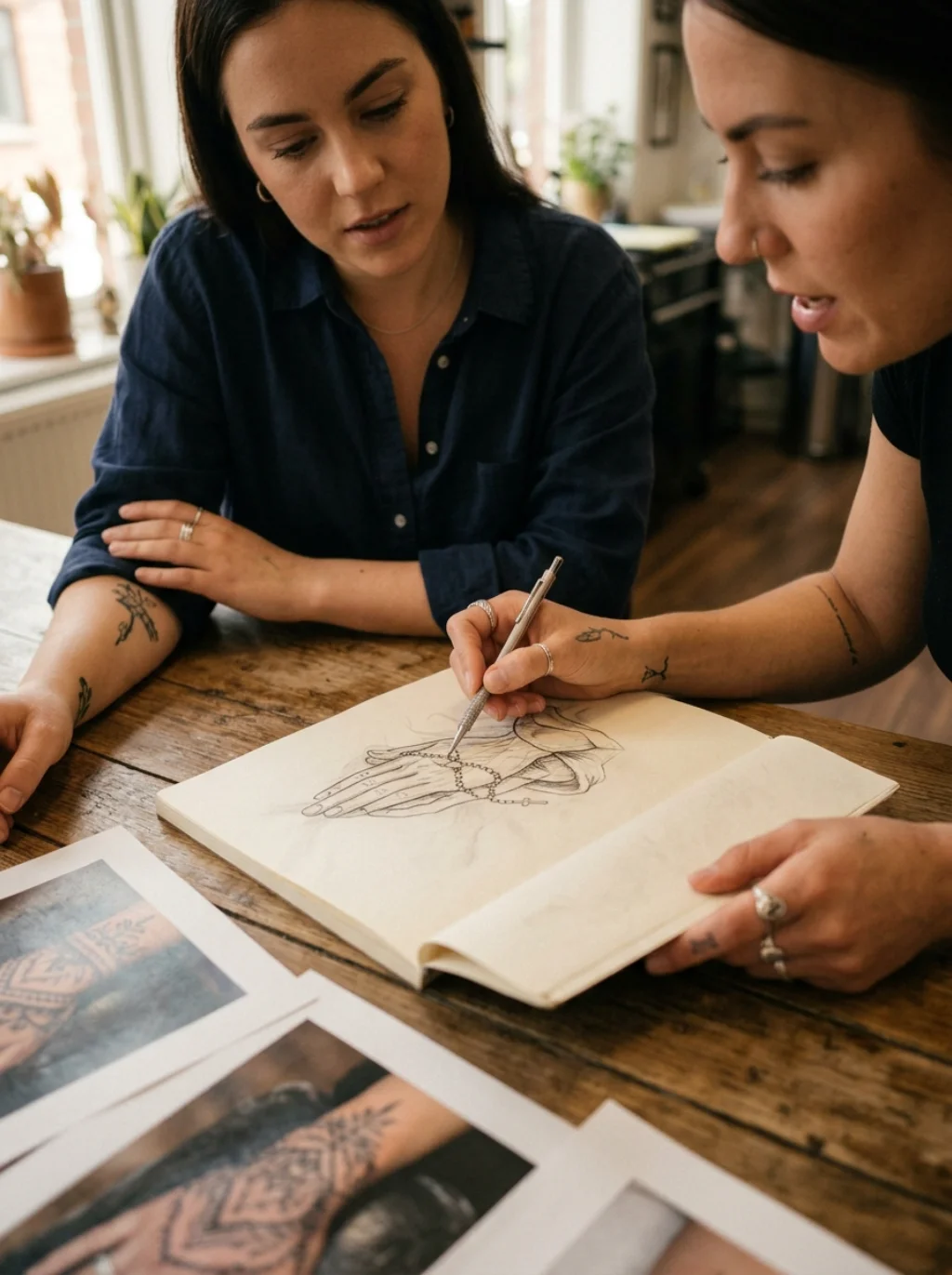
The hands are widely considered the most difficult anatomical subject in visual art. Every art school student learns this early — the human hand’s complexity of form, the subtlety of its proportional relationships, and the specificity of its articulation across different positions make it the benchmark of observational drawing skill. Praying hands tattoo realistic execution requires an artist who has genuinely mastered hand anatomy — not one who can produce competent general tattooing but one who specifically demonstrates excellence in complex figurative work.
Professional tattoo artist consultation specifically for a praying hands tattoo should include a focused review of the artist’s healed portfolio in the specific style you’re pursuing — realism, fine line, blackwork, or traditional — with emphasis on any hand-specific work they can show. Ask specifically about their anatomical reference process: do they use photographic reference, draw their own reference, or work from Dürer directly? Knuckle detail realistic hand tattoo quality is the most reliable indicator of genuine hand-drawing mastery and should be assessed carefully in any artist’s existing work before booking.
Pain Levels and Healing Realities at Different Praying Hands Tattoo Placements
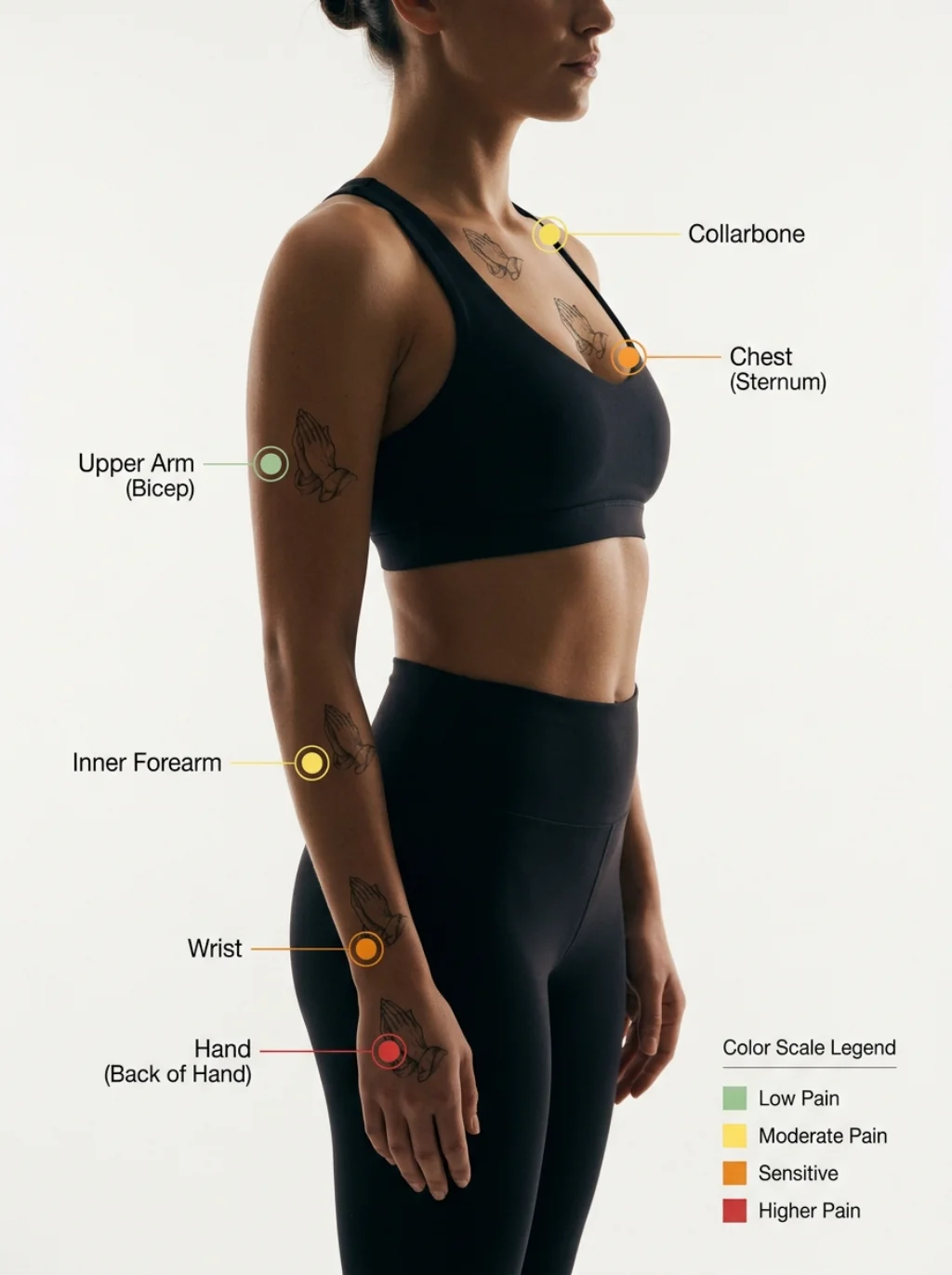
Best placement for praying hands tattoo decisions should account for pain tolerance, visibility preference, and the specific design scale alongside the healing and longevity implications of each location. The inner forearm — the most popular placement — rates moderate on pain scales for most people, heals reliably due to stable skin and good circulation, and ages well because it receives moderate sun exposure compared to outer forearm locations.
Hand placement tattoo pain consideration for those considering placement directly on the hand itself — perhaps a small praying hands design on the back of the hand or between the thumb and index finger — involves significantly higher discomfort than forearm work due to the concentration of nerve endings and the thin skin over bone. Hand tattoos also fade more quickly than most placement locations due to constant movement, washing, and sun exposure. Praying hands tattoo collarbone placement offers moderate pain and excellent visual placement for medium-scale designs, while chest placement ranges from moderate to significant pain depending on proximity to the sternum bone.
| Placement | Pain Level | Healing Speed | Longevity | Best Design Scale |
|---|---|---|---|---|
| Inner forearm | Moderate | Fast | Excellent | Medium to large |
| Chest/sternum | Moderate-high | Medium | Very good | Medium to large |
| Collarbone | Moderate-high | Medium | Good | Small to medium |
| Upper arm | Low-moderate | Fast | Excellent | Any scale |
| Hand | High | Slow | Fair | Small only |
| Wrist | Moderate | Fast | Good | Small to medium |
Aftercare Essentials That Protect the Fine Detail That Makes These Tattoos Sacred
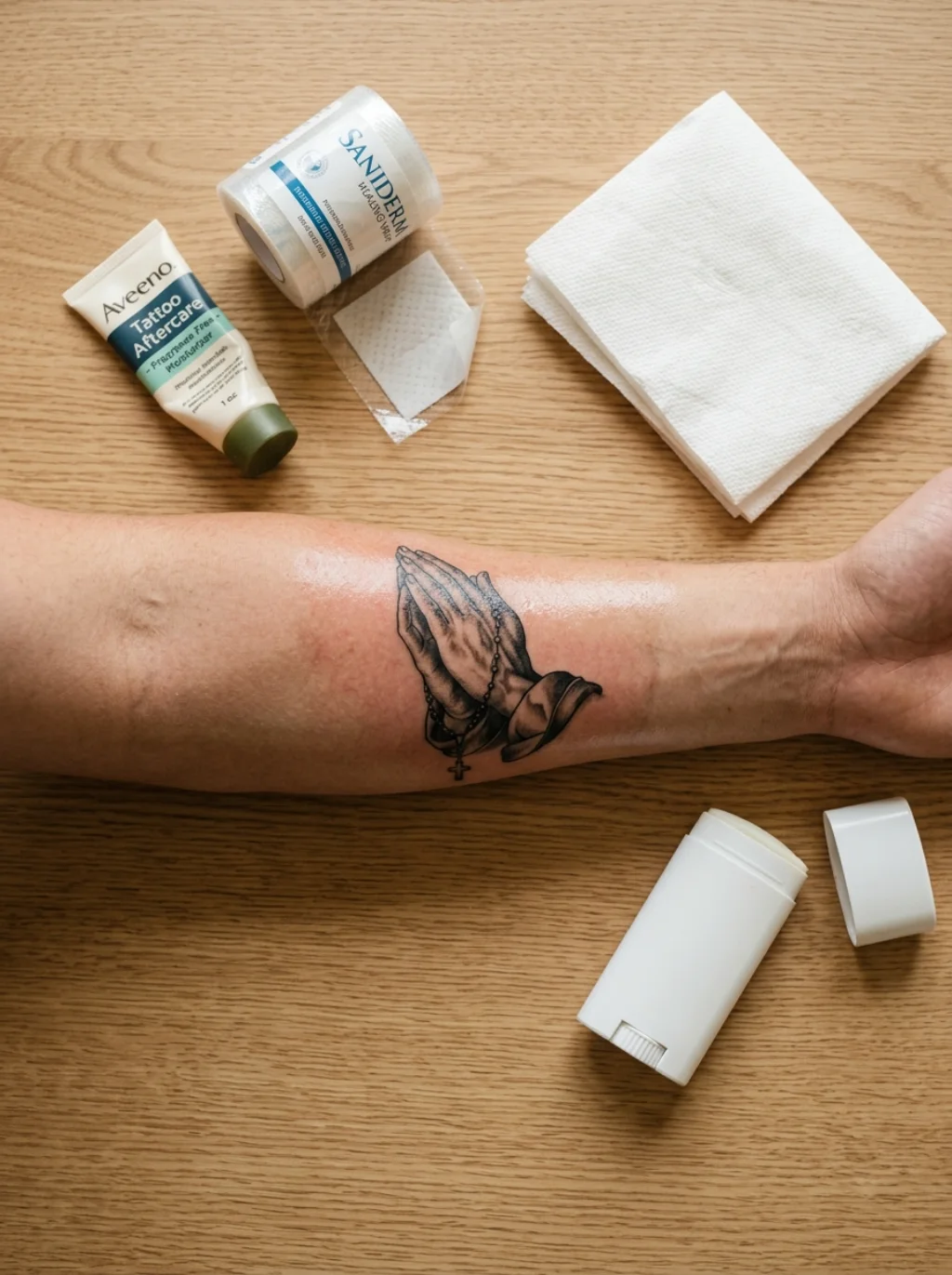
Praying hands tattoos with significant fine detail — skin fold rendering in realism work, hairline script in bible verse additions, delicate floral botanical elements — require aftercare more attentive than bolder, simpler designs. Fine line and realism work heals through a more critical phase because the narrow ink deposits are more vulnerable to disruption during the peeling and settling stages than the broad ink fields of traditional tattooing.
The fundamental aftercare protocol for praying hands tattoo designs with fine detail involves: keeping the fresh tattoo covered with a breathable healing wrap for the first three to five days rather than exposing it to open air, moisturizing with fragrance-free, alcohol-free lotion twice daily once the wrap is removed, avoiding sun exposure completely during healing (three to four weeks minimum), and protecting the healed tattoo with SPF 50+ sunscreen thereafter on any location that receives regular sun. Praying hands tattoo religious designs that include scripture in fine script are particularly vulnerable to sun fading — the hairline letters lose their legibility years faster on sun-exposed placements without consistent UV protection.
Frequently Asked Questions
What does a praying hands tattoo mean?
Praying hands tattoo meaning and symbolism encompasses devotion, humility, petition, faith, and spiritual connection across multiple traditions. In the American context, the design most commonly communicates Christian faith — the act of addressing God through prayer. Memorial praying hands tattoos add another meaning dimension: honoring the departed through the spiritual language they practiced in life. More broadly, the design communicates a relationship with something greater than the individual self, whatever that relationship’s specific theological content may be.
Where is the best placement for a praying hands tattoo?
Best placement for praying hands tattoo depends on your visibility preference and design scale. The inner forearm is the most popular placement — highly visible, good surface area, reliable healing, and excellent long-term ink retention. The chest and sternum offer symbolic resonance (placement over the heart) and adequate space for larger compositions. The collarbone suits medium-scale designs beautifully. The wrist suits small and minimalist versions. Hand placement itself involves higher pain, faster fading, and more frequent touch-up requirements.
How detailed can a small praying hands tattoo be?
Small praying hands tattoo ideas for women and men at the 1.5 to 2.5 inch scale can incorporate meaningful compositional complexity — the hands themselves plus a small cross, a word, or a simplified floral element — when executed by an artist with experience at micro or small-scale work. What small-scale work cannot accommodate is fine photorealistic skin fold rendering, highly detailed scripture, or elaborate compositional elements that require space to read clearly. Praying hands tattoo simple designs that reduce the subject to its essential form work best at small scale.
Do praying hands tattoos work in color?
Yes, with important caveats. Praying hands tattoo realistic work in color requires an artist with specific color realism expertise — the skin tone accuracy required for convincing realistic hands in color is considerably more technically demanding than black and grey work. Traditional and neo-traditional praying hands tattoos incorporate color beautifully through the bold line and flat fill approach that characterizes those styles. Praying hands tattoo watercolor designs use color as an atmospheric element rather than a realism tool, which is a more forgiving approach. Color placements near the skin tones of the hands require particular care to avoid muddy, indistinct results.
How long do praying hands tattoos take to heal?
The surface healing phase — when the tattoo peels and the color appears dull and hazy — typically completes in two to three weeks for forearm and chest placements. Full dermal healing, when the ink has fully settled into the dermis and the color appears as it will long-term, takes three to six months. Praying hands tattoo chest and sternum placements may experience slightly longer healing due to the movement of breathing. During the healing period, sun exposure must be avoided entirely and aftercare followed consistently to protect the fine detail that makes these tattoos meaningful.
Can I include a portrait of a deceased person with praying hands as a memorial?
Absolutely, and this is among the most powerful memorial tattoo formats available. Praying hands memorial tattoo design ideas that incorporate portrait elements of the departed person require the most technically demanding combination in all of tattooing — portrait realism plus hand anatomy realism in a single composition. This requires an artist who specifically specializes in portrait work and demonstrates excellence in their portfolio of healed portrait tattoos. Bring the highest-quality photograph available of your loved one to the consultation — the quality of the photographic reference directly determines the ceiling of what the portrait can achieve.
What should I look for in an artist for a realistic praying hands tattoo?
Realistic praying hands tattoo design ideas require an artist who specifically demonstrates hand anatomy mastery in their existing portfolio. Look for healed examples of hand work in their specific style. Assess the quality of skin fold rendering, the dimensional quality of knuckle detail, and the consistency of line quality in any fine-line work. Ask about their reference process and their experience with this specific subject. Praying hands tattoo realistic execution is among the most technically demanding in tattooing — the gap between artists who can genuinely execute it and those who cannot is significant, and the healed portfolio is the only reliable evidence of where any given artist sits.
Conclusion
Praying hands tattoos endure because they speak to something that outlasts every trend in body art culture: the human need to acknowledge the sacred, to memorialize the beloved, and to wear one’s deepest convictions visibly on the body. From the photorealistic Dürer-referenced chest piece to the minimalist fine-line wrist detail, from the rosary-wrapped memorial to the watercolor-washed spiritual statement, every version of this design participates in a visual tradition that stretches from the streets of contemporary American tattoo studios back through the devotional art of the Renaissance and further still into humanity’s earliest expressions of reverence. Choose your artist with genuine care. Choose your elements with genuine intentionality. And carry the design you choose with the understanding that the hands on your skin are participating in something much older and much larger than any single tattoo can contain.
4 Comments