
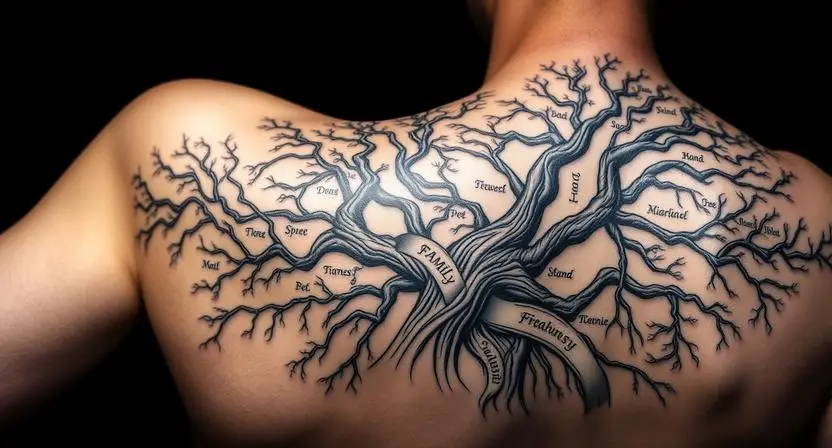
There is something quietly extraordinary about carrying your entire lineage on your skin. Not a name. Not a date. An entire living system — roots reaching downward into everything that came before you, branches extending outward into everyone who came after. Family tree tattoos occupy a singular space in body art because they accomplish something no other motif can: they make the invisible visible. They render the abstract concept of family — love, loss, loyalty, time, identity — into a tangible organic form that lives and breathes on skin for the rest of your life. This guide covers every dimension of this extraordinary tattoo category, from ancient cultural roots to modern design techniques, so you can approach your own piece with the depth it deserves.
The Ancient Language of Roots Every Tree Tattoo Speaks Without Words
Trees have served as humanity’s most universal symbol for thousands of years across every continent and civilization. They don’t require translation. A root system pressing deep into dark earth, a trunk weathering decades of storm, branches reaching toward light — every person on the planet reads that visual language immediately and instinctively. Symbolic tree body art meaning taps directly into this ancient reservoir of shared human understanding in ways that more literal tattoo motifs simply cannot access.
Lineage and legacy tattoo themes built around tree imagery connect the wearer to something far older than any single family. The tree has represented life, death, rebirth, connection, and endurance in Egyptian hieroglyphs, Mesopotamian cylinder seals, Celtic stone carvings, and Norse mythology simultaneously. When you choose a tree for your genealogy tattoo art, you’re borrowing the full symbolic weight of ten thousand years of human meaning-making. That’s not an overstatement. It’s the quiet truth beneath every branch and root rendered in ink.
Sacred Symbols Across Cultures That Shaped the Family Tree Tattoo Forever
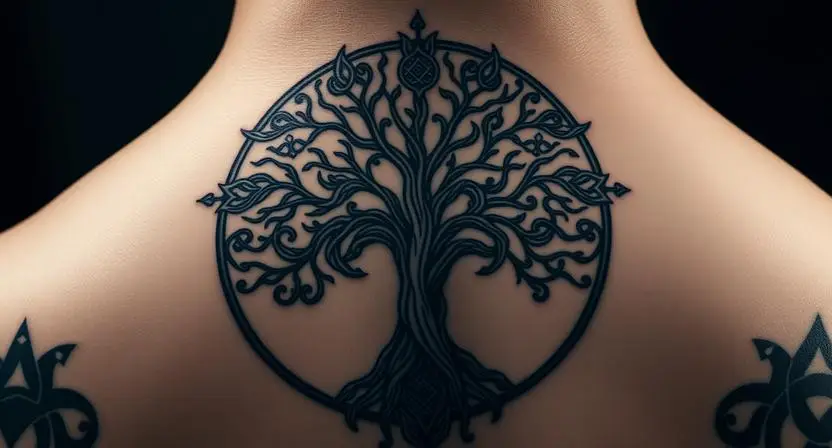
The Norse Yggdrasil world tree stands as perhaps the most cosmically ambitious tree symbol in human history. In Norse cosmology, Yggdrasil — an immense ash tree — connects nine separate worlds, with its roots touching the realm of the dead and its branches brushing the home of the gods. Warriors, scholars, and poets understood their entire existence as existing within the architecture of this single tree. That worldview — life as an interconnected vertical system of roots, trunk, and branches — maps with extraordinary precision onto the modern family tree tattoo concept.
The Celtic tree of life symbol operates in equally profound territory. Celtic cultures believed trees were living portals between the physical world and the spiritual realm. The interweaving knotwork that characterizes Celtic knotwork tree design represents the eternal, unbroken nature of family bonds — lines that have no beginning and no end, just as true kinship has no terminus. Across the Pacific, the Koru spiral family tattoo of Māori tradition represents new life, growth, and strength drawn from ancestral roots. The Maori tā moko tree symbolism carries entire genealogical narratives in a single curving form. Every culture that ever looked at a tree saw their family reflected back.
| Cultural Tree Symbol | Origin | Core Meaning | Tattoo Style Fit |
|---|---|---|---|
| Yggdrasil | Norse | Cosmic connection, nine worlds | Blackwork, neo traditional |
| Celtic Tree of Life | Celtic | Eternal bonds, spiritual portal | Celtic knotwork, fine line |
| Koru Spiral | Māori | New life, ancestral strength | Traditional, geometric |
| Banyan Tree | Hindu/Buddhist | Immortality, many lives from one root | Realism, blackwork |
| Cherry Blossom Tree | Japanese | Life’s fleeting beauty, ancestors | Watercolor, Japanese irezumi |
| Oak Tree | European | Strength, endurance, longevity | Blackwork, realism |
Family Tree Tattoos and the Profound Stories They Carry Beneath the Skin
What does a family tree tattoo mean at its most personal level? It means something entirely different to every person who wears one and that variability is precisely what makes this motif so enduring. For one person the tree represents survival — a family that weathered poverty, migration, or loss and still produced branches full of living people. For another it’s pure celebration — a large, joyful, intergenerational household rendered in botanical form. For another still it’s grief — a family tree memorial tattoo honoring lost loved ones who are gone but remain architecturally present in every branch above.
Family narrative tattoo artistry at its finest treats the tree not as a generic symbol but as a specific portrait. The species matters. An oak tree symbolism in tattoos context communicates strength and deep-rooted endurance across generations. A weeping willow memorial tattoo speaks to grief held gracefully. A cherry blossom tree ancestry tattoo references Japanese cultural philosophy about the beautiful impermanence of life — every bloom falling at its appointed time. A banyan tree roots tattoo meaning piece communicates a family with multiple branches all drawing life from a single shared source. These aren’t interchangeable choices. Each species tells a fundamentally different story.
The Celtic Knotwork Legacy That Transformed Tree Tattoos Into Sacred Art
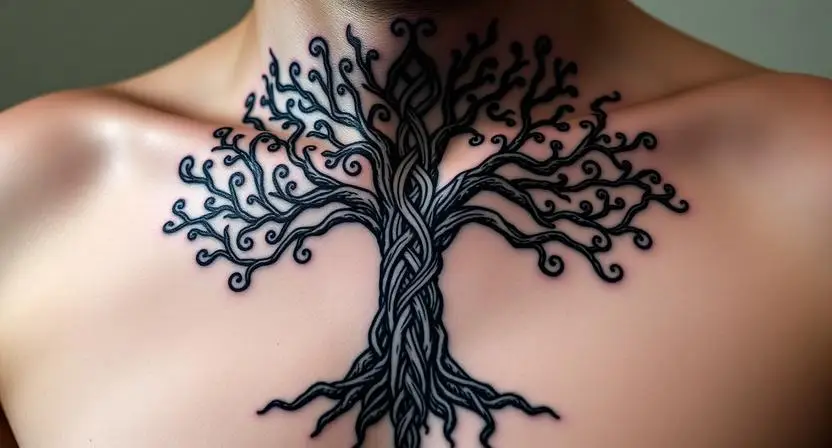
The celtic family tree tattoo meaning runs deeper than pure decoration. Celtic knotwork — those endlessly interlacing lines that form leaves, branches, and root systems without a single visible beginning or end — was developed by Celtic monks and craftspeople as a deliberate theological statement. The absence of terminus in the knotwork represented the eternal nature of the divine and by extension the eternal nature of familial love. When Celtic artists applied this visual language to tree forms, they created something genuinely sacred: a symbol of family that declared its bonds to be literally without end.
Celtic knotwork family tree tattoo design in contemporary body art draws on this heritage with full intentionality. The interlacing branches of a Celtic family tree don’t simply divide and extend — they weave back into each other, loop around shared points, and create a visual field of connection that reads as both organic and mathematically precise simultaneously. Ancestral roots body art in this tradition photographs with extraordinary richness because the knotwork creates depth and visual complexity that rewards extended looking. An artist fluent in Celtic linework can render a family tree that contains entire genealogical narratives within the interweaving of a single branch system.
Roots Deep Enough to Hold Storms — the Symbolism That Moves People to Tears
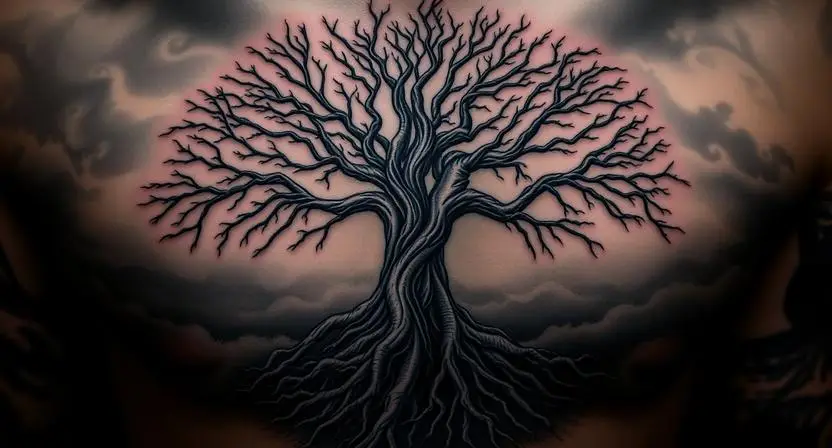
Roots tattoo symbolism carries a weight that few other tattoo elements can match. The root system of a tree is invisible in nature — it exists entirely underground, unseen, doing its most critical work in total darkness. That invisibility makes it a perfect metaphor for ancestry: the generations you never met, the sacrifices you’ll never fully know about, the love that was expressed before you existed. Roots and identity tattoo themes resonate with particular force among people whose families navigated immigration, displacement, or cultural loss — the roots represent everything carried forward through the silence of generations.
Generational bond tattoo concepts built around root imagery speak to something even more primal than named ancestors. The root system says: you are held. You didn’t arrive here by accident. Every challenge your family survived — famine, war, heartbreak, poverty, illness — exists encoded in the root structure that holds you upright today. Birth and growth tattoo symbolism within the root-and-trunk relationship represents that transmission of strength from the unseen past into the visible present. When people sit in the tattoo chair and see their root system taking shape beneath the trunk, artists report that tears are genuinely common. Not sadness. Recognition.
Branches That Bear Names — Turning a Family Tree Into a Personal Chronicle
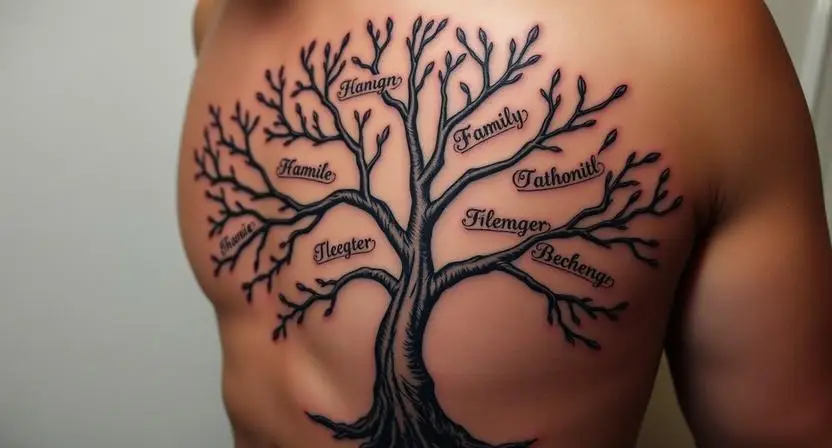
Family tree tattoo with names on branches transforms a beautiful symbol into a living document. Each name placed on a branch anchors the design to a specific human being — a grandfather born in 1923, a mother born in 1958, a child born last year. The tree stops being a generic representation of family and becomes an irreplaceable portrait of your family. Tree with names tattoo designs require particular collaboration between client and artist because the typography must serve the composition rather than fight it — names should curve naturally with the branch they inhabit rather than sitting awkwardly across it.
Family tree tattoo with names and dates adds a biographical precision that moves the design firmly into chronicle territory. Birth dates anchor each branch to historical time. Death dates, where included, transform the piece into a family tree memorial tattoo that honors both the living and the gone within the same organic structure. Family tree tattoo with birth dates placed at specific nodes in the branch system creates a visual timeline — the eye travels up the tree through time, from the oldest names near the trunk to the newest names at the furthest reaching tips of the highest branches. That temporal journey, rendered in botanical form, is genuinely one of the most moving things tattoo art can accomplish.
The Spine and Back Canvas — Nature’s Perfect Architecture for Tree Tattoos
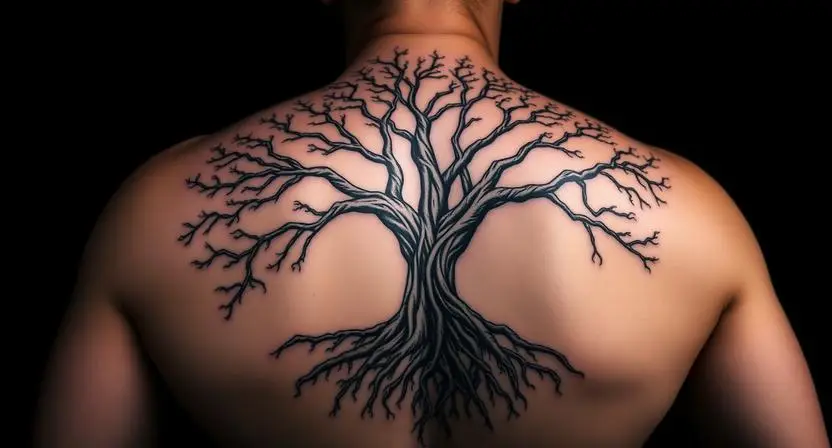
Large family tree tattoo on back or spine placements represent the most architecturally logical choice in all of body art. The spine is a vertical axis — just as a tree trunk is a vertical axis. The back spreads horizontally on both sides — just as branches extend laterally from a trunk. The placement isn’t just convenient. It’s genuinely structural. A tree tattoo placed along the spine uses the body’s own skeleton as the literal armature of the composition. Root systems descend toward the lumbar region. The trunk climbs the thoracic spine. Branches spread across the shoulder blades. The body becomes the tree.
you may also like this:22 Jesus Tattoos Ideas for Meaningful Faith Inspired Ink
Family tree tattoo on back designs at full scale can accommodate extraordinary detail — individual leaves, named branches, carved initials, birds resting in the canopy, falling leaves, knotwork details, and biographical dates can all coexist within a back piece without crowding. Large family tree back tattoo ideas work best when the artist plans the composition around the body’s natural topography: using the shoulder blade curvature to give the canopy dimension, using the lower spine’s slight inward curve to suggest the tree’s emergence from earth. A back piece of this ambition typically requires fifteen to thirty hours across multiple sessions. The investment in time matches the investment in meaning.
Chest and Forearm Placements That Give Family Tree Tattoos Maximum Impact
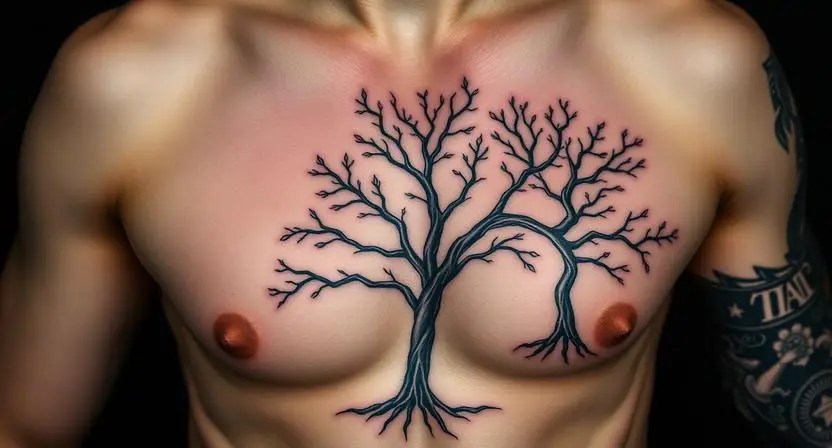
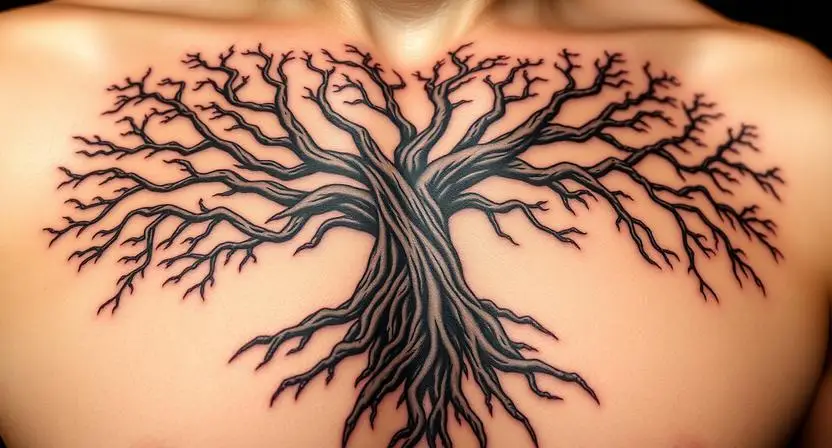
Best placement for family tree tattoo decisions beyond the back center on two primary locations: the chest and the forearm. The chest placement — particularly a tree whose roots begin at the sternum and whose branches spread across the pectoral muscles toward the shoulders — positions the family tree directly over the heart. That anatomical symbolism is so obvious it barely needs articulation but it lands with full emotional force every time someone sees it. Family tree chest tattoo for men design ideas frequently incorporate a bolder, more architectural approach — heavier lines, deeper shadows, more dramatically rendered bark texture.
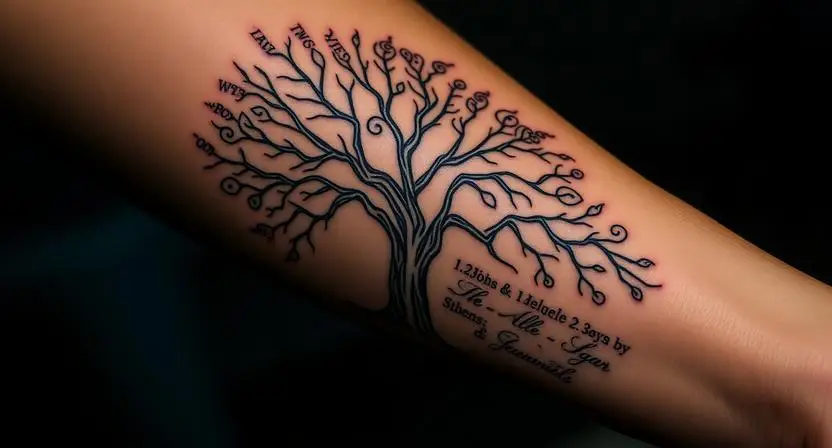
Arm tree tattoo ideas offer a different kind of visual logic. The forearm’s length accommodates a full vertical tree composition naturally — roots at the wrist, trunk climbing the forearm, canopy spreading as it approaches the elbow. A family tree sleeve tattoo extends this concept to fill the entire arm from wrist to shoulder, incorporating the tree within a broader nature scene that might include landscapes, animals, celestial elements, and biographical details. Family tree wrist tattoo designs in the minimalist register place a small but perfectly formed tree on the inner wrist — intimate, personal, visible to the wearer with every glance downward.
Fine Line Mastery That Makes Botanical Tree Tattoos Look Impossibly Delicate
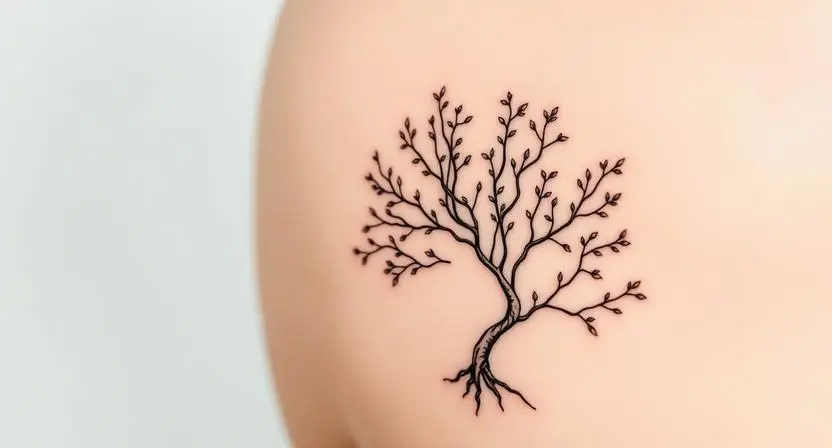
Fine line tattoo technique branches have revolutionized what’s possible in detailed tree tattoo designs. Where traditional tattooing required bold outlines to maintain legibility over years of skin aging, fine line work operates at the absolute threshold of precision — single-needle hairline strokes that render individual leaf veins, delicate twig bifurcations, and the subtle texture of young bark in breathtaking detail. A minimalist family tree tattoo fine line style piece can contain extraordinary botanical complexity while occupying a relatively small area of skin.
Detailed botanical family tree tattoo rendering in the fine line style draws directly from the tradition of scientific botanical illustration — the kind found in 18th and 19th century natural history publications where engravers rendered plant anatomy with almost surgical precision. Botanical family tree tattoo designs in this mode treat the tree as a biological specimen as much as a symbol, capturing the specific vascular branching patterns, the precise angle of petioles, and the characteristic silhouette of a specific species rather than a generic tree. The result is a piece that rewards extreme close inspection — a tattoo that reveals more detail the more carefully you look.
Blackwork Shadows and Bold Lines That Give Tree Tattoos Their Raw Power
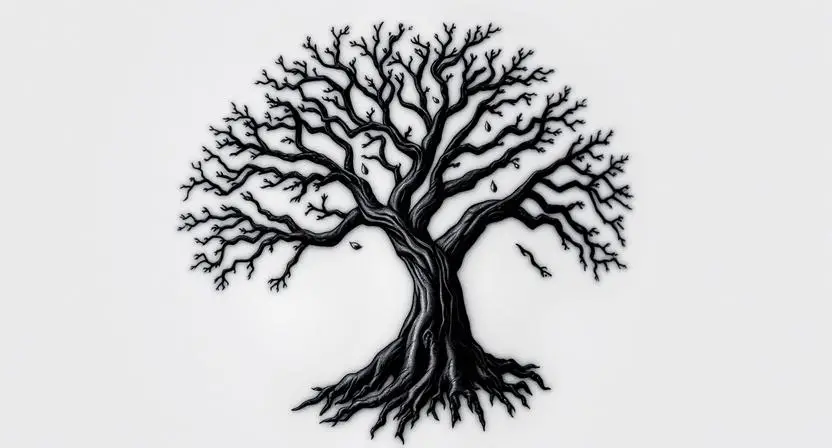
Blackwork tattoo style tree designs operate at the opposite end of the aesthetic spectrum from fine line work and every bit as powerfully. Blackwork uses heavy ink saturation, bold outlines, and dramatic negative space to create compositions of striking visual weight. A blackwork family tree tattoo doesn’t whisper — it declares. The bold, uncompromising darkness of heavily inked bark texture and solid shadow areas communicates strength, permanence, and the kind of deep-rooted endurance that the best family roots tattoo designs aspire to.
Black and grey tree tattoo work sits between pure blackwork and fine line — using graduated grey washes to create three-dimensional depth, atmospheric shadow, and the illusion of genuine surface texture on bark, root, and branch. This technique allows for realistic botanical illustration tattoo results that look less like drawings and more like photographs of actual trees. Roots and branches tattoo compositions rendered in black and grey realism produce some of the most visually arresting results in the entire family tree tattoo designs category because the tonal range creates genuine drama — deep shadow at the root level giving way to lighter, airier rendering at the canopy tips.
Watercolor Washes Behind Tree Tattoos That Turn Skin Into Living Canvas
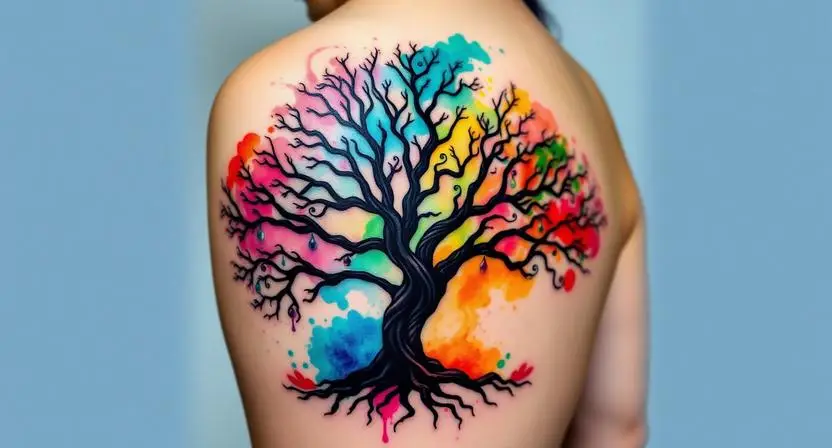
Watercolor family tree tattoo with bird details sits at the most painterly and emotionally expressive end of the stylistic spectrum. The watercolor technique — loose, bleeding washes of color that suggest rather than define, bleed beyond edges rather than respecting them, and layer transparently to create luminous depth — transforms a family tree from a drawn image into something that genuinely resembles a painting pressed permanently into skin. Watercolor tattoo technique family pieces photograph with extraordinary beauty because the soft color bleeding catches light in ways that solid ink applications cannot.
Nature inspired family bond tattoos rendered in watercolor frequently incorporate the tree as a precise fine-line or blackwork anchor set against a loose, abstract wash of color that suggests sky, seasonal light, or the specific palette of a landscape meaningful to the family. Deep violet and gold washes behind an oak suggest autumn in the specific region where the family has its roots. Soft green and blue washes behind a cherry blossom tree ancestry tattoo reference Japanese spring light. Family tree tattoo with birds additions — swallows, sparrows, or doves rendered in fine line within the canopy — add biographical detail while giving the composition movement and life that a static tree alone can’t generate.
Geometric Precision and Organic Form — the Design Tension That Wins Every Time
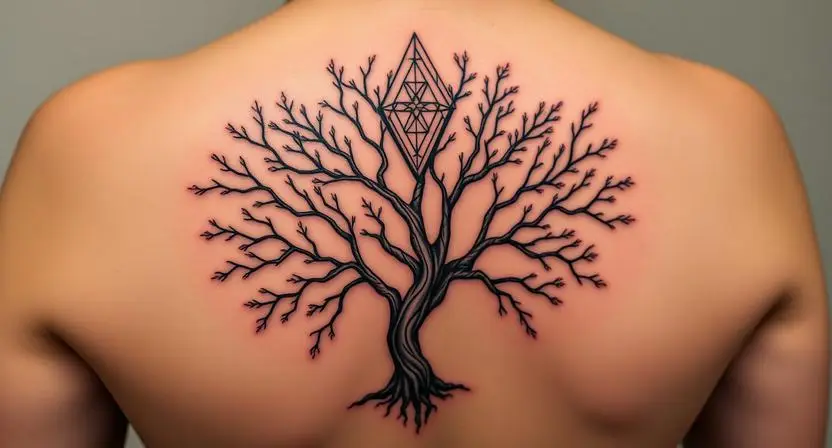
Geometric tree tattoo design creates one of the most visually compelling tensions available in botanical body art. The contrast between the rigid mathematical precision of geometric forms — triangles, hexagons, sacred geometry grids, precise linework — and the organic, irregular, living form of a tree produces a visual dialogue that the eye returns to repeatedly. Sacred geometry tree tattoo designs use this tension deliberately: a tree whose root system or canopy dissolves into geometric patterns suggests the underlying mathematical order beneath all natural forms.
Mandala tree of life tattoo designs take this geometric-organic conversation further by situating the tree within a radially symmetrical mandala framework — the tree’s trunk at the mandala’s center, branches and roots following the mandala’s expanding circular geometry. Negative space family tree tattoo technique achieves something different again: using the untattooed skin as the tree’s form, with the surrounding inked areas defining the tree’s shape through contrast. This approach creates a ghostly, luminous tree that seems to glow from within the skin itself. Silhouette tree tattoo style strikes a middle ground — the tree is a solid inked form without internal detail, its power derived entirely from the specificity and expressiveness of its outer silhouette.
Memorial Branches — Honoring the Gone Through the Living Architecture of Trees
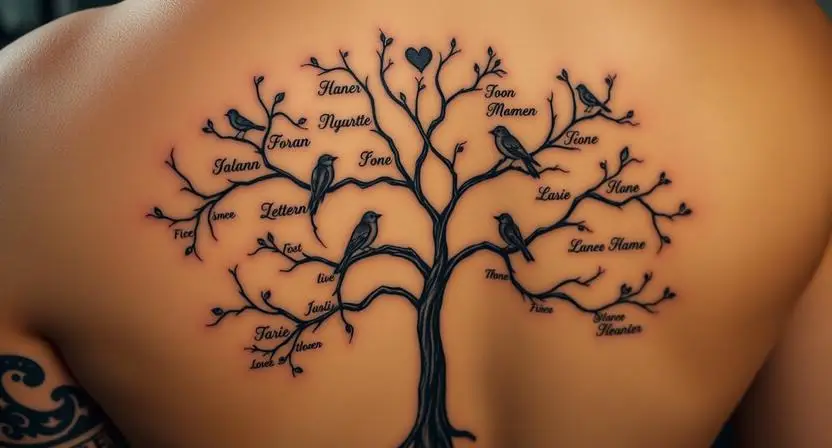
Family tree tattoo with falling leaves memorial designs represent one of the most emotionally charged applications of tree imagery in body art. The falling leaf is nature’s own symbol of completed life — beautiful in its descent, returning to the earth that produced it, making space for new growth in its absence. A single falling leaf added to a family tree tattoo transforms the piece from a celebration of the living into a tribute that holds both joy and grief simultaneously within the same organic composition.
Living memory tattoo design built around memorial branches operates on the understanding that the dead don’t disappear from family trees — they become part of the structure that holds everything else upright. A branch that bears a grandparent’s name and dates doesn’t end abruptly in the composition. It continues, perhaps without new named branching above it, but structurally present in the architecture that supports every living branch extending from it. Family legacy ink design that incorporates this principle produces pieces of extraordinary emotional intelligence — tattoos that understand loss as structural rather than simply absent.
Siblings Inked Together — Matching Family Tree Tattoos That Seal a Bond Forever
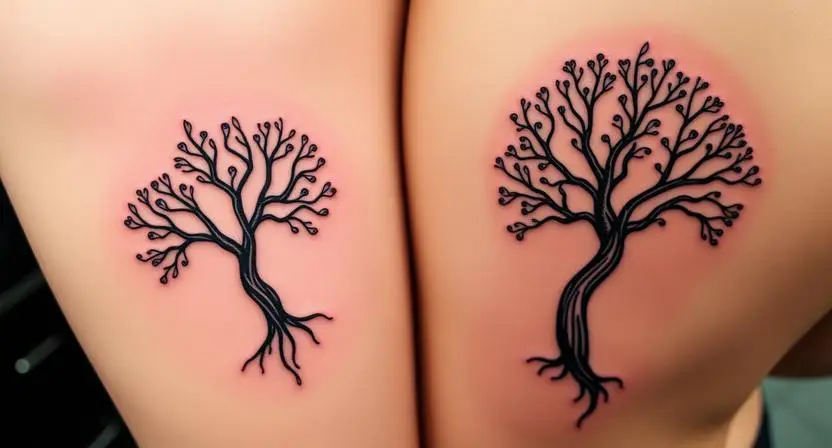
Matching family tree tattoo ideas for siblings represent some of the most creatively ambitious collaborative tattoo projects in contemporary body art. The concept is architecturally elegant: each sibling carries one part of the same tree. One sibling wears the root system and trunk. Another wears the main branches. A third carries the canopy. Separately, each piece is beautiful and complete in itself. Together — when siblings stand side by side — the three tattoos assemble into a single, unified tree that no individual can contain alone. The metaphor writes itself.
Family tree matching tattoo ideas don’t require literal fragmentation of a single composition to succeed as a sibling tribute. Matching tree of life tattoo ideas in identical styles but on different placements communicate shared heritage through visual consistency rather than physical assembly. Family bond tattoo ideas for siblings also work powerfully when each piece incorporates the same species of tree — the same oak, the same birch, the same cherry blossom — but in each sibling’s chosen style and scale. The botanical sameness declares common root. The stylistic individuality honors separate personhood. That balance is the entire story of sibling relationship expressed in ink.
From Minimalist Twig to Full Sleeve — Scaling Your Tree Tattoo With Purpose
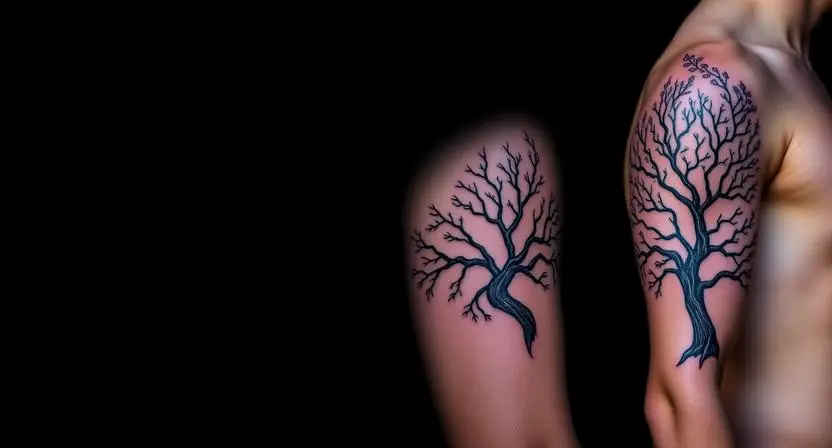
Scale is the single most consequential decision in family tree tattoo designs beyond the design itself. A small family tree tattoo ideas piece on the inner wrist containing just a delicate twig-and-root sketch can carry as much emotional weight as a full back piece — the intimacy of the placement compensates for the reduction in visual scale. But the technical reality is firm: how large does a family tree tattoo need to be for fine detail is not a matter of preference. It’s a matter of physics. Fine line detail below a certain size threshold will spread and blur as skin ages. An artist who recommends going larger is protecting your investment.
Family tree sleeve tattoo with nature elements represents the most expansive scaling option: a full arm sleeve that situates the tree within a complete environmental composition — roots emerging from soil rendered at the wrist, trunk climbing through the forearm, canopy spreading across the upper arm, with surrounding elements — birds, clouds, celestial bodies, or landscape features — filling the negative space organically. Minimalist tree tattoo designs at the opposite end of the scale spectrum use single-line or two-line techniques that suggest a tree in the minimum number of marks possible. Both approaches are valid. The choice between them comes down to the story you need to tell and the canvas you’re willing to dedicate to telling it.
The Names, Dates, and Initials That Transform a Tree Tattoo Into a Sacred Text
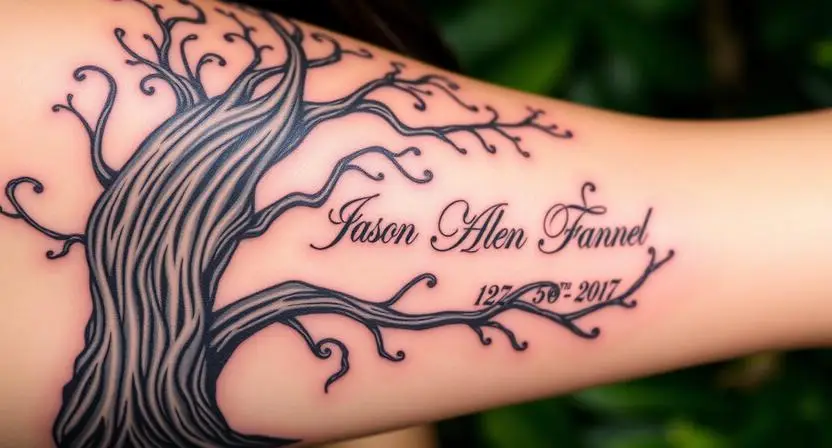
Tree tattoo ideas with initials approach biographical inscription with elegant restraint — the initial carved into bark texture or integrated into the branch structure at the point where that person’s branch diverges from the main trunk. This mimics the actual practice of carving initials into living trees, a tradition with centuries of romantic and familial history behind it. Tree trunk tattoo with initials carved designs render the initials as if genuinely etched into the wood surface, complete with the shadow cast by carved-away bark. The effect is tactile and immediate — you can almost feel the carving with your fingertip.
Family tree tattoo with names and birth years as a typography-forward approach requires an artist with genuine lettering skill alongside their drawing ability. The font choice matters enormously here — serif fonts with classical proportions suggest permanence and heritage, script fonts suggest warmth and personal intimacy, and sans-serif minimal fonts read as modern and restrained. Family tree tattoo design with meaningful quote additions — a line of family poetry, a motto, a single word in Latin or a native language — placed at the root level or inscribed along the trunk create a textual anchor that gives the entire composition a verbal dimension to complement its visual one. Text and image together produce a piece that speaks in two languages simultaneously.
Choosing an Artist Whose Portfolio Proves They Can Render Wood, Root, and Bark
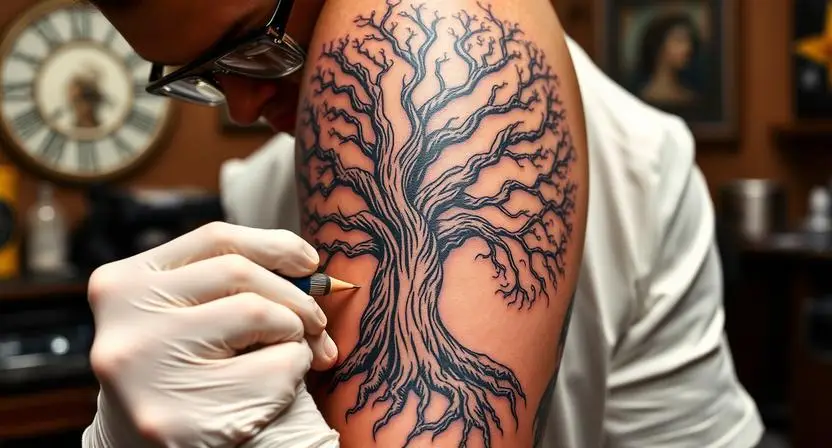
Portfolio evaluation for family tree tattoo designs requires a specific and educated eye. Trees are among the most technically demanding subjects in botanical tattooing precisely because they require mastery of three entirely distinct surface textures — rough, fissured bark on the trunk; smooth, tapering wood on the branches; and the varied flat plane of individual leaves — all within a single composition. An artist who renders bark convincingly but produces flat, unconvincing leaves has a gap in their technical vocabulary that will show in your finished piece.
Realistic botanical illustration tattoo capability shows itself clearly in healed portfolio work. Look specifically for healed examples rather than fresh tattoos — fresh ink always looks sharper than it will at twelve months. Examine how the artist handles the transition from thick trunk to thin branch: does that tapering feel natural and organic or does it feel mechanical and arbitrary? Look at their root systems — do the roots feel like they’re genuinely pressing into earth or do they sit flatly on the skin’s surface? Family tree tattoo incorporating cultural symbols at the highest level requires an artist fluent in both botanical illustration and cultural iconography. That combination is rare. Find it before you book.
Aftercare Rituals That Preserve Every Fine Branch and Delicate Leaf Long Term
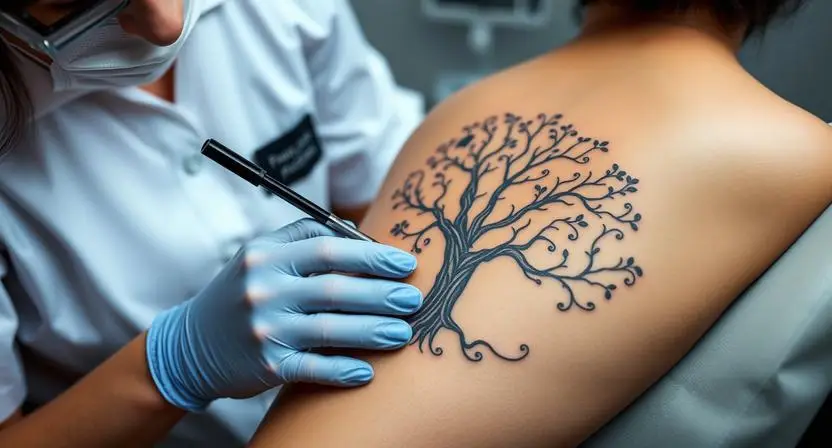
Fine line tattoo technique branches demand more rigorous aftercare discipline than bold traditional tattoos because the thinner the line, the more vulnerable it is to degradation during the healing process and the years that follow. The first two weeks are critical and non-negotiable: keep the tattoo clean with fragrance-free antimicrobial soap applied with clean fingertips, apply a thin layer of unscented moisturizer two to three times daily, never submerge in water, and keep the piece entirely out of direct sunlight until fully healed.
Long-term preservation of detailed botanical family tree tattoo rendering comes down almost entirely to sun protection applied consistently for the life of the tattoo. UV radiation is the single most destructive force acting on tattoo ink over time — it breaks down pigment molecules, causes colors to fade, and accelerates the spreading of fine lines into broader, softer marks. Apply minimum SPF 50 to every tattooed area exposed to daylight, every day, without exception. Botanical family tree tattoo pieces with fine leaf detail and delicate branch linework will reward this discipline with remarkable clarity decades after the initial healing. Neglect it and the finest detail work will degrade within years.
The Mistakes That Turn Beautiful Tree Tattoos Into Lifelong Regrets
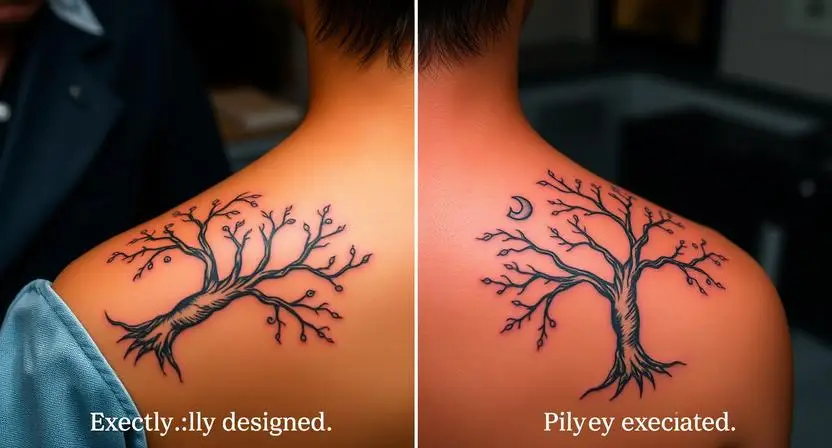
The most consistently destructive mistake in family tree tattoo planning is choosing an artist based on price or availability rather than demonstrated technical competency in the specific style required. A blackwork specialist cannot necessarily execute a watercolor family tree tattoo — the technical vocabularies are completely different disciplines. A portrait realist may not understand the organic irregularity that makes botanical work feel alive. Always choose the artist whose existing portfolio demonstrates specific mastery of the exact style you’re commissioning.
Sizing errors represent the second major category of regret. Clients consistently request pieces that are too small for the detail level they want and artists who don’t push back on this do their clients a serious disservice. Family tree tattoo with roots and branches in fine line style needs meaningful size to maintain legibility as the skin ages. Placement on high-motion joints — elbows, knees, wrists, fingers — accelerates ink migration and fading at rates that will frustrate you within five years. Simple family tree tattoo for beginners should still be sized and placed with longevity in mind. A piece this meaningful deserves to look as powerful at fifty as it did at twenty-five.
Family Tree Tattoos for Men — Bold Compositions That Command Attention
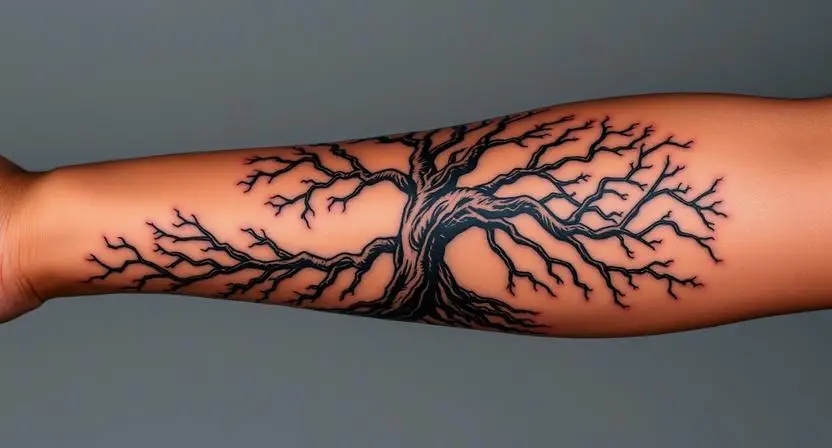
Family tree tattoo ideas for men tend toward compositions with more visual weight, bolder linework, and more dramatically rendered environmental detail than their counterparts in other demographic categories. This isn’t a rule — it’s a pattern that reflects how men often conceptualize family strength: as something structural, deeply rooted, weathering-resistant. Family tree chest tattoo for men design ideas frequently feature a gnarled, ancient oak or a massive banyan with aerial roots visible — trees that communicate decades of endurance rather than delicate youth.
Blackwork tattoo style tree work performs particularly powerfully in men’s family tree tattoo compositions because the bold, uncompromising nature of solid black ink communicates exactly the kind of permanence and conviction that men often want their family tributes to express. A banyan tree roots tattoo meaning piece covering the chest and extending onto both shoulders creates one of the most architecturally powerful compositions in body art — the tree’s multiple trunk-like aerial roots mirroring the multiple lines of a man’s family origin with extraordinary organic logic.
Family Tree Tattoos for Women — Graceful Designs With Extraordinary Depth
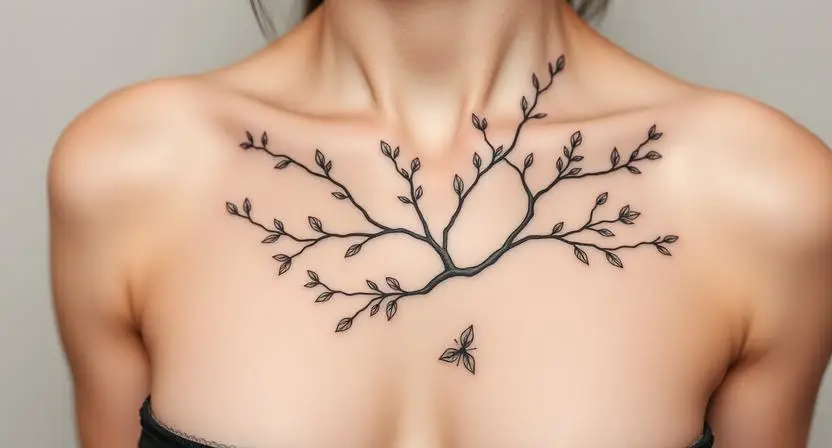
Family tree tattoo ideas for women embrace a broader stylistic range than any other demographic category in this motif — from the ethereally delicate to the bold and architectural, with the full stylistic spectrum between occupied with equal conviction. Watercolor family tree tattoo pieces appear most frequently in women’s family tree commissions and the reason is clear: watercolor’s soft, painterly quality communicates emotional warmth and creative vitality in ways that harder-edged styles don’t access as naturally.
Family tree tattoo for parents — designed specifically to honor children — represents one of the most emotionally charged specific applications of this motif. A mother’s tree with branches bearing each child’s name and birth date transforms the parental body into a living monument to the family she created. Organic family portrait in ink approaches that incorporate each family member’s personality into the composition — through the species of flower that grows from their branch, the bird that nests at their name, the season reflected in their portion of the canopy — create pieces of such personalized depth that they function as genuinely irreplaceable biographical documents.
Cultural Roots and Personal Identity — Designing a Tree That Truly Belongs to You
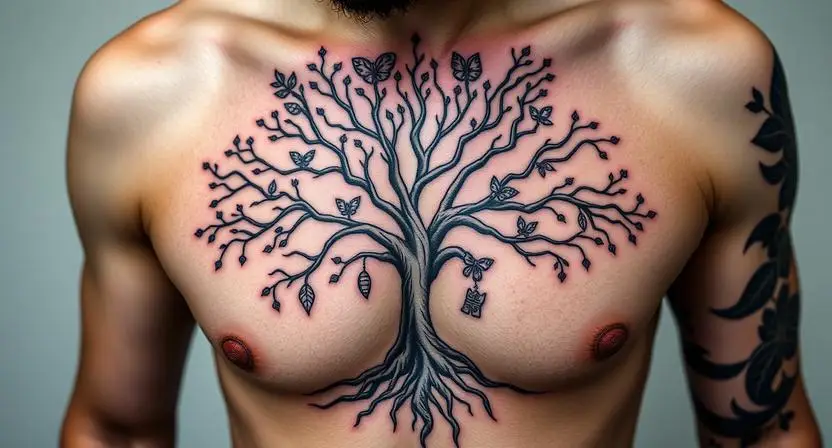
Family tree tattoo incorporating cultural symbols produces the most personally resonant and socially meaningful work in the entire genre. A family with Irish heritage might commission a celtic knotwork family tree tattoo design that incorporates the specific regional knotwork patterns of their ancestral county. A Japanese-American family might frame their tree within the visual language of Japanese irezumi tree motif with cherry blossoms, koi, and specific seasonal imagery. A Māori-heritage wearer might integrate Koru spiral family tattoo forms into the root system that holds their tree upright.
Heritage preservation through ink through culturally specific family tree design is one of the most profound things tattoo art can accomplish in the modern era. For families whose cultural traditions were disrupted by colonization, diaspora, or assimilation, the act of encoding cultural symbols into a family tree tattoo reclaims something that might otherwise be lost. Intergenerational family tree tattoo tribute pieces that deliberately incorporate the visual language of a specific cultural heritage declare: this is where we come from and we carry it forward intentionally. That declaration, worn permanently on the body, is one of the most powerful acts of cultural self-determination available to anyone in any generation.
Frequently Asked Questions
What does a family tree tattoo symbolize?
A family tree tattoo symbolizes lineage, heritage, the strength of family bonds, generational connection, and the relationship between those who came before and those who follow. Family tree tattoo symbolism explained varies by design element: roots represent ancestry and the unseen foundation of identity, the trunk represents the family’s core strength, branches represent individual members and family lines, and leaves often represent children or new growth.
Where is the best placement for a family tree tattoo?
Family tree tattoo placement ideas depend on the scale and complexity of the design. The back and spine offer the most architecturally logical placement for large compositions. The chest positions the tree over the heart for maximum symbolic resonance. The forearm accommodates medium-scale vertical compositions naturally. The wrist suits small family tree tattoo ideas with minimalist detail. Each placement creates a different relationship between the body’s anatomy and the tree’s own structural logic.
Can a family tree tattoo include names and birth dates?
Absolutely. Family tree tattoo with names and dates is one of the most popular and meaningful approaches to this motif. Names are typically placed directly on the branches they represent, while dates appear beneath or alongside the name. Family tree tattoo incorporating birth dates works best when the typography is designed as part of the composition rather than added as an afterthought — the lettering style, size, and placement should be planned into the original design with the same care as the botanical elements.
What tattoo style works best for a detailed family tree design?
Black and grey tree tattoo realism produces the most photographically detailed results. Fine line tattoo technique branches create extraordinary botanical delicacy. Blackwork tattoo style tree delivers maximum visual impact and permanence. Watercolor tattoo technique family pieces offer the most painterly emotional warmth. The best style is the one whose visual language aligns most naturally with what you want the finished piece to communicate — strength, delicacy, warmth, or permanence each have their corresponding stylistic expression.
How large does a family tree tattoo need to be for fine detail?
For fine line tattoo technique branches with individual leaf detail, named branches, and root complexity, the minimum recommended size is approximately four inches for a simplified design and eight or more inches for a fully detailed composition. Detailed botanical family tree tattoo rendering requires sufficient scale for fine lines to maintain their individual integrity as skin ages over decades. Artists who recommend larger sizes are protecting the long-term quality of the work — trust that recommendation completely.
Conclusion
A Family Tree Tattoo Is Not Just Art — It Is the Story of Everyone Who Made You
Family tree tattoos are among the most profound and intellectually ambitious things tattoo art has ever been asked to accomplish. They aren’t decoration. They’re declarations — permanent, public, physical commitments to the people, places, and histories that made you who you are. Every root pressed into skin is an ancestor acknowledged. Every branch is a relationship honored. Every named node in the composition is a human being whose existence contributed something irreplaceable to yours.
The decision to carry this on your body for the rest of your life deserves everything this guide has tried to give it — research, deliberation, cultural consideration, stylistic education, and the patience to find an artist whose technical mastery genuinely matches the emotional scale of what you’re asking them to render. Your family tree is unlike anyone else’s in the world. The tattoo that carries it should be just as singular. Choose every element with the full weight of what it represents and the result will be something that doesn’t just look extraordinary — it will feel, every single day, like exactly what it is: the story of everyone who made you, carried forward into every room you enter, for the rest of the life they gave you.
1 Comment